
Which Countries Are Most Loved—and Which Are Viewed Most Negatively—in 2026?
Public opinion can shape international relations almost as much as military power or economic strength.
Countries that are trusted often find it easier to attract tourists, foreign investment, students, skilled workers, and diplomatic partners. Countries viewed negatively may still be powerful, but they can face greater resistance, suspicion, and isolation.
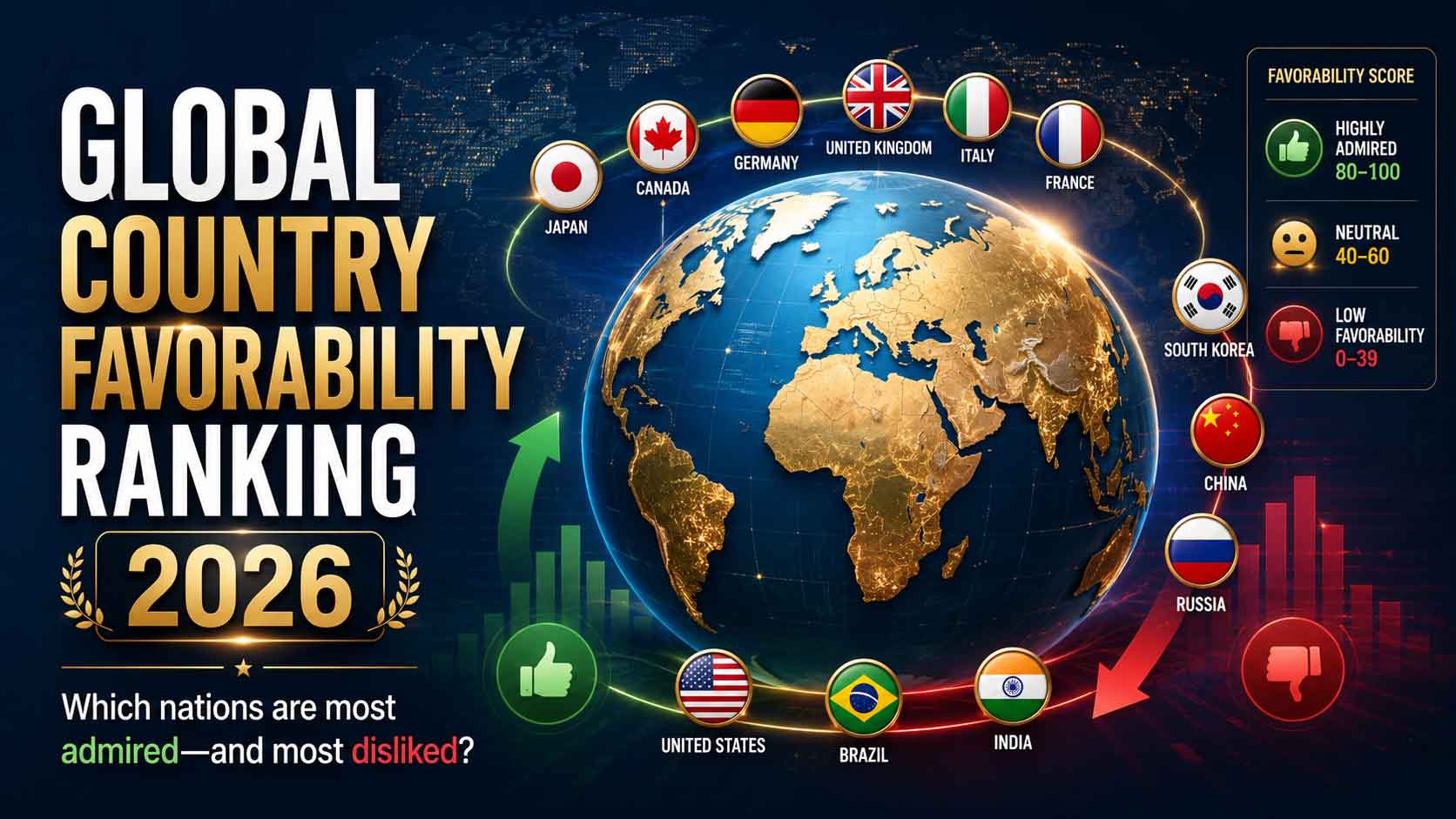
This report compares how twelve of the world’s leading economies are viewed internationally in 2026:
- Japan
- Canada
- Germany
- United Kingdom
- Italy
- France
- South Korea
- China
- Brazil
- India
- United States
- Russia
The results reveal an important truth: the world’s most powerful country is not necessarily the world’s most admired country.
How This Ranking Was Created
There is no single worldwide poll that asks every person on Earth to rank all countries from most loved to most hated.
This report therefore combines several types of international research:
- Direct country-favorability polling
- National reputation surveys
- Trust in government and leadership
- Cultural and tourism appeal
- Global influence
- Soft-power measurements
- Strong favorable and unfavorable sentiment
Sources include the Pew Research Center, Gallup, Ipsos, Brand Finance, and the Anholt-Ipsos Nation Brands Index.
The ranking should be understood as an evidence-based comparison—not a perfect measurement of how every individual feels.
The word “hated” should also be used carefully. A country may be viewed unfavorably because of its government, wars, foreign policy, or leadership while its people, culture, food, history, and traditions remain respected.
The 2026 Country Favorability Ranking
1. Japan
Japan currently holds the strongest overall international reputation among the countries examined.
It is widely associated with:
- Safety
- Reliability
- Technological achievement
- High-quality products
- Cultural traditions
- Tourism
- Social order
Japan ranked first in the Anholt-Ipsos Nation Brands Index and remained near the top of global reputation and soft-power studies.
Japanese animation, food, automobiles, electronics, history, and popular culture have also strengthened the country’s appeal across generations.
Japan is not viewed positively everywhere. Historical grievances continue to affect attitudes in China and South Korea. Nevertheless, its worldwide reputation remains exceptionally strong.
Overall assessment: The most consistently admired country in this comparison.
2. Canada
Canada remains one of the world’s most trusted and positively viewed countries.
It is often associated with:
- Friendliness
- Tolerance
- Political stability
- Natural beauty
- Social inclusion
- Peaceful international conduct
Canada’s economic problems—including expensive housing, strained public services, and political disagreements—have not seriously damaged its international reputation.
The country is generally viewed as less aggressive and less politically threatening than many larger powers.
Overall assessment: Highly trusted, stable, and broadly admired.
3. Germany
Germany is respected internationally for competence, manufacturing, engineering, education, and institutional reliability.
Its strongest reputation comes from being viewed as:
- Organized
- Technically advanced
- Economically important
- Politically responsible
- Central to European stability
Germany may be more respected than emotionally loved. Its reputation is often based on competence rather than warmth or cultural affection.
Economic stagnation, energy problems, and political uncertainty have weakened Germany’s image somewhat, but it remains one of the world’s most respected countries.
Overall assessment: Highly respected for competence and stability.
4. United Kingdom
The United Kingdom continues to possess enormous cultural influence.
Its international reputation is supported by:
- The English language
- Universities
- Music
- Film and television
- Literature
- The BBC
- The monarchy
- Historic institutions
British culture travels far beyond the country’s borders.
However, Britain’s colonial history continues to produce negative feelings in parts of Africa, Asia, the Caribbean, and the Middle East. Brexit and political instability have also weakened confidence in the country’s recent direction.
Even so, the United Kingdom remains one of the most internationally recognized and culturally influential nations.
Overall assessment: Strong cultural reputation despite political and historical controversy.
5. Italy
Italy is one of the world’s most culturally loved countries.
It is admired for:
- Food
- Art
- Architecture
- Fashion
- History
- Music
- Tourism
- Lifestyle
Italy may rank even higher when people are asked specifically about travel, culture, food, or emotional warmth.
Its weaknesses are mainly connected to government instability, public debt, bureaucracy, and perceptions of political inefficiency.
People may question Italy’s government, but they rarely question the country’s cultural importance.
Overall assessment: One of the world’s most culturally attractive countries.
6. France
France remains internationally influential through its culture, diplomacy, cuisine, fashion, history, and global political role.
France is admired for:
- Art
- Architecture
- Food and wine
- Fashion
- Tourism
- Literature
- Independent foreign policy
However, France can also be polarizing.
Its colonial history, policies in Africa, domestic protests, and reputation for cultural arrogance sometimes produce negative attitudes.
Despite those controversies, France remains one of the most recognizable and influential countries in the world.
Overall assessment: Widely admired but more polarizing than Japan, Canada, or Italy.
7. South Korea
South Korea’s international reputation has risen dramatically.
Its growing influence comes from:
- Technology
- Automobiles
- Electronics
- Korean television dramas
- Film
- Beauty products
- Food
- K-pop
South Korea’s cultural growth is especially strong among younger audiences.
Companies such as Samsung, Hyundai, Kia, and LG helped establish the country’s technological reputation. Korean entertainment later expanded its cultural influence.
Political instability, tensions with North Korea, and historical disputes with neighboring countries remain weaknesses.
Overall assessment: One of the fastest-rising national reputations in the world.
8. China
China is one of the most complicated countries to rank.
It is powerful, increasingly influential, and deeply polarizing.
A 2026 Pew Research Center survey found that a median of approximately 51% of respondents across the countries surveyed held a favorable view of China, compared with 39% who held an unfavorable view.
However, attitudes differed dramatically by region.
China received stronger ratings in parts of:
- Africa
- Latin America
- South Asia
- Southeast Asia
It received much weaker ratings in:
- Japan
- Canada
- The United States
- Western Europe
- Several advanced democracies
China is often viewed positively for trade, infrastructure investment, technology, and economic development.
It is viewed negatively because of concerns involving:
- Authoritarian government
- Surveillance
- Human rights
- Territorial disputes
- Taiwan
- Treatment of minorities
- Restrictions on political freedom
China’s growing influence does not mean that it is universally loved. It means that more countries now view China as economically important and difficult to ignore.
Overall assessment: Increasingly favorable in many developing countries but deeply distrusted elsewhere.
9. Brazil
Brazil generally has a warm cultural image.
It is associated with:
- Music
- Sports
- Carnival
- Beaches
- Natural beauty
- Social warmth
- Cultural diversity
Brazil is not necessarily disliked. Its lower ranking mostly reflects weaker scores in government effectiveness, security, global influence, and institutional stability.
Crime, corruption concerns, political division, and environmental disputes have damaged its reputation.
Nevertheless, Brazil’s people and culture are often viewed more positively than its political institutions.
Overall assessment: Generally liked, but less trusted institutionally.
10. India
India’s international image is mixed and varies greatly by region.
Its strengths include:
- Ancient history
- Religion and philosophy
- Food
- Film
- Technology
- Economic growth
- A large international diaspora
- Democratic traditions
India is increasingly important economically and politically.
However, its reputation is weakened by concerns involving:
- Religious nationalism
- Minority rights
- Pollution
- Poverty
- Social inequality
- Treatment of women
- Political freedom
India often receives stronger ratings in countries with major trade, cultural, or diaspora connections.
Because current worldwide favorability data for India are less complete, its exact position should be treated cautiously.
Overall assessment: Increasingly influential, but viewed differently across regions.
11. United States
The United States presents the clearest example of the difference between power and favorability.
America remains the world’s strongest soft-power country because of its:
- Technology
- Universities
- Entertainment
- Financial markets
- Military power
- Media
- Music
- Entrepreneurship
- Global companies
However, current international favorability has declined sharply.
A 2026 Pew Research Center survey found a median of approximately 37% of respondents holding a favorable view of the United States, while 57% held an unfavorable view.
American favorability was reported near historic lows in several long-standing allied countries, including:
- Canada
- Germany
- France
- Italy
- South Korea
- United Kingdom
This decline does not necessarily mean the world rejects American people or American culture.
Many people continue to admire American universities, movies, music, businesses, technology, and opportunities.
Negative attitudes are more commonly connected to:
- Political leadership
- Foreign policy
- Military interventions
- Racial conflict
- Political polarization
- Economic pressure
- Perceptions of hypocrisy
- Questions about whether the United States remains a reliable partner
The United States remains extremely influential, but influence and trust are no longer moving together.
Overall assessment: The most powerful country in the ranking, but currently one of the least favorably viewed.
12. Russia
Russia is currently the most negatively viewed country among the major economies examined.
A 2026 Pew survey found that approximately 34% of respondents across the countries surveyed held a favorable view of Russia, while 59% held an unfavorable view.
Negative attitudes were especially strong in Europe, Canada, and the United Kingdom.
Russia received more positive ratings in countries including:
- India
- Indonesia
- Malaysia
- Sri Lanka
- Thailand
- Bangladesh
Russia’s cultural history remains respected. The country has made major contributions to:
- Literature
- Classical music
- Science
- Space exploration
- Art
- Military history
However, these achievements are currently overshadowed by perceptions involving:
- The war in Ukraine
- Political repression
- Military threats
- Authoritarian leadership
- Cyberoperations
- Government propaganda
- Threats toward neighboring countries
Russia remains globally influential, but much of that influence is based on military power, energy resources, and fear rather than broad affection.
Overall assessment: The most negatively viewed country in this comparison.
Final Ranking: Most Favorably Viewed to Most Negatively Viewed
| Rank | Country | Overall international assessment |
|---|---|---|
| 1 | Japan | Most consistently favorable |
| 2 | Canada | Highly trusted and admired |
| 3 | Germany | Highly respected for competence |
| 4 | United Kingdom | Strong cultural and institutional reputation |
| 5 | Italy | Exceptionally strong cultural appeal |
| 6 | France | Favorable but sometimes polarizing |
| 7 | South Korea | Rapidly improving international image |
| 8 | China | Improving but deeply divided by region |
| 9 | Brazil | Generally liked but less influential |
| 10 | India | Mixed and regionally variable |
| 11 | United States | Extremely influential but currently broadly unfavorable |
| 12 | Russia | Most consistently negatively viewed |
Direct 2026 Favorability Comparison
Current Pew polling provides the clearest directly comparable results for China, the United States, and Russia.
| Country | Favorable | Unfavorable | Net balance |
|---|---|---|---|
| China | 51% | 39% | +12 |
| United States | 37% | 57% | −20 |
| Russia | 34% | 59% | −25 |
These figures represent median results across the countries surveyed. They should not be interpreted as the opinion of the entire world population.
Regional differences remain extremely important.
A country may be strongly admired in one region and deeply distrusted in another.
Power Is Not the Same as Respect
The most important lesson from this report is that military, economic, and technological power do not automatically create international affection.
The United States remains the world’s most influential country but has suffered a significant decline in international trust.
China has improved its favorability in many parts of the developing world, even while remaining deeply unpopular in several advanced democracies.
Russia remains powerful but broadly distrusted.
Japan and Canada demonstrate a different kind of strength. Their international reputations are based more on trust, stability, culture, safety, and reliability than on military force.
Country favorability can also change quickly.
Wars, economic crises, humanitarian conduct, political leadership, trade disputes, racial conflict, and treatment of neighboring countries can transform a nation’s reputation within only a few years.
The countries that maintain the strongest long-term reputations will not necessarily be those that demand the most attention. They may be the countries that demonstrate the greatest reliability, fairness, stability, and respect for others.
Sources Consulted
This report draws upon international research and polling from:
- Pew Research Center
- Gallup
- Ipsos
- Anholt-Ipsos Nation Brands Index
- Brand Finance Global Soft Power Index
Polling results measure public perception at a particular moment. They should be interpreted as evidence of current international attitudes—not as permanent judgments about an entire country or its people.
Discover more from Master Yahshua Messiah
Subscribe to get the latest posts sent to your email.