
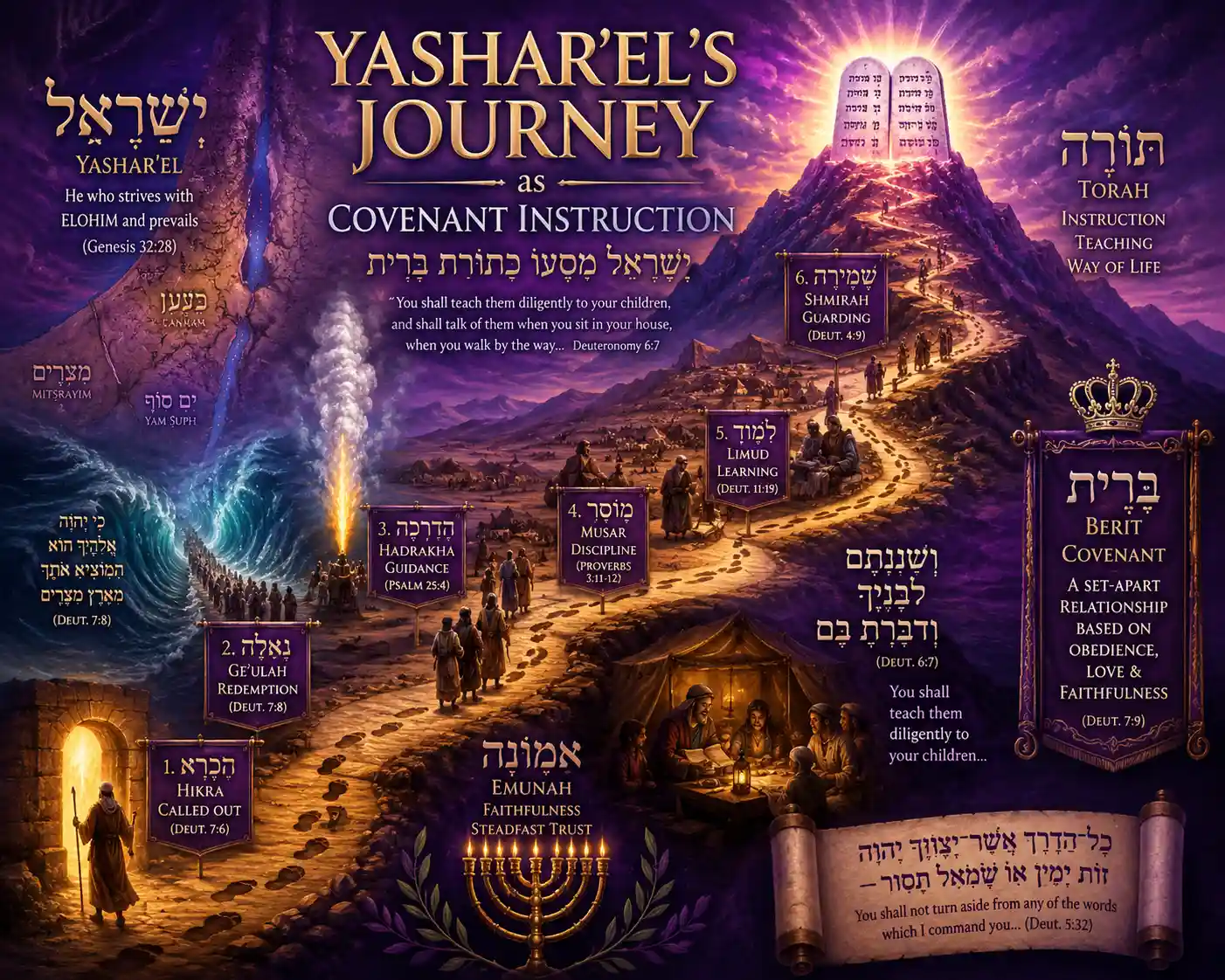
On how the story of a nation becomes the map of a life
By Larry Yahu-aman Biakpara
Many read the journey of Yashar’el as history alone. But Scripture repeatedly reveals something deeper — their story was also written as instruction, warning, witness, and pattern for those who come afterward. Sha’ul made this plain:
“Now these things became our examples…”
1 Corinthians 10:6
“Now all these things happened unto them for ensamples: and they are written for our admonition…”
1 Corinthians 10:11
The pattern reveals how covenant formation often unfolds — both collectively and personally. One story, two scales: nation and individual.
Egypt Before Deliverance
Yashar’el began in Mitsrayim — in bondage, oppression, dependency, and identity suppression. Likewise, many people begin bound to fear, sin, worldly systems, survival thinking, and a false sense of who they are.
Yahuah often calls people out before He calls them up. Deliverance comes before inheritance. Even Yahusha walked within this pattern. Hoshea wrote of the nation:
“When Israel was a child, then I loved him, and called my son out of Egypt.”
Hosea 11:1
And this was later applied to Yahusha himself:
“Out of Egypt have I called my son.”
Matthew 2:15
One covenant pattern. Two scales.
The Wilderness Process
Yashar’el did not leave Egypt and immediately enter the promise. There was wilderness. Because physical separation is easier than inward transformation.
The wilderness exposed fear, murmuring, pride, impatience, hidden rebellion, and dependency. Personal wilderness seasons carry the same weight — waiting, pressure, instability, uncertainty, testing, isolation. But wilderness is not abandonment. Wilderness is restructuring. The Torah says plainly:
“And thou shalt remember all the way which Yahuah thy Elohim led thee these forty years in the wilderness, to humble thee, and to prove thee, to know what was in thine heart…”
Deuteronomy 8:2
Pressure reveals what is truly inside.
The Murmuring Pattern
Yashar’el repeatedly desired to return to Egypt — because bondage can become familiar. People often prefer familiar slavery over unfamiliar freedom. Many leave Egypt outwardly while still carrying Egypt inwardly. The outer exodus may happen quickly. The inner exodus can take years.
Hebrews uses the wilderness generation as a direct warning to individuals:
“Today if ye will hear His voice, harden not your hearts…”
Hebrews 3:15
Covenant Before Inheritance
At Sinai, covenant came before land. This pattern matters. The world teaches possession first, alignment later. But covenant teaches alignment first, inheritance second. Yahuah develops faithfulness, stewardship, obedience, and responsibility before expansion, influence, and visibility follow.
From Outward Law to Inward Alignment
First came tablets of stone. Then came the promise of Torah written within. The movement is always from outward instruction toward inward transformation — from “I obey because I was told” toward “I obey because I have become aligned.” The prophet Yirmeyahu recorded the promise:
“I will put My Torah in their inward parts, and write it in their hearts…”
Jeremiah 31:33
Covenant eventually becomes internal. The law migrates from stone to soul.
Appointed Times as Remembrance
Yashar’el was given Sabbaths, moedim, memorials, and cycles of remembrance — because people forget under pressure. Without remembrance, they drift back into surrounding systems. The appointed times are covenant remembrance structures, as the command at Shemoth makes clear:
“And it shall be for a sign unto you upon your hand, and for a memorial between your eyes…”
Shemoth / Exodus 13:9
For a practical guide to the Hebrew months, appointed times, biblical feasts, and major Jewish observances: See Jewish Holiday Calendar 2026: Hebrew Months, Feasts and Holiday Dates.
For an ancient text that gives additional attention to covenant, Sabbath, appointed times, genealogy, and Israel’s history: Explore the Ethiopian Orthodox Bible: 88 Books Free PDF, which includes the Book of Jubilees.
Identity Restoration
Yashar’el repeatedly struggled with identity. They desired kings like the nations, systems like the nations, and practices like the nations. Likewise, many people build their sense of self around survival, performance, fear, and the approval of surrounding systems. But covenant restores identity. Yahuah repeatedly calls, separates, renames, and restores function — Abram became Abraham; Ya’aqov became Yashar’el. In Scripture, identity is consistently tied to covenant function.
For the covenant background behind this restored identity: Read Origin of the Chosen People to trace the covenant line from Abraham through Isaac and Ya’aqov to Yashar’el and the twelve tribes.
The Golden Calf Pattern
When Mosheh delayed, the people built a substitute. This pattern is not merely ancient history. When people fear waiting, they create replacements — visible security, fleshly solutions, self-made systems, artificial certainty — because trust during delay is genuinely difficult. The golden calf is not only an act of ancient idolatry. It is premature self-stabilization outside trust in Yahuah. It is what we build when we stop believing He will return.
The Generational Pattern
The generation that left Egypt largely died in the wilderness. Deliverance alone was not enough. Some mindsets could not carry inheritance. Likewise, parts of us must die — pride, false identity, rebellion, fear, performance, dependency — before covenant maturity can emerge. Not everything that crosses the Red Sea crosses the Jordan.
The Yahusha Pattern
Consider the parallel: Yashar’el was called out of Egypt, passed through the waters, entered the wilderness, and was tested repeatedly. Yahusha, likewise, was called out of Egypt, passed through the water at immersion, entered the wilderness, and was tested for forty days. Where Yashar’el stumbled, Yahusha remained faithful — revealing perfect covenant obedience within the very pattern the nation struggled to uphold. He did not abolish the pattern. He fulfilled it.
The Remnant Pattern
Throughout Scripture, preservation happens through a faithful remnant. Not all who leave Egypt enter promise. Not all who hear truth embrace covenant. Sha’ul wrote:
“Even so then at this present time also there is a remnant according to the election of grace.”
Romans 11:5
He also describes branches being grafted into the olive tree — covenant preservation sustained not by numbers alone, but through alignment and faithfulness. The olive tree stands. The question is always whether the branch is drawing from the root.
“And if some of the branches be broken off, and thou, being a wild olive tree, wert grafted in among them, and with them partakest of the root and fatness of the olive tree…”
Romans 11:17
Empire vs. Covenant
Imperial systems tend toward control, hierarchy, domination, and outward pressure — especially when detached from covenant responsibility. Covenant operates differently: through relationship, responsibility, faithfulness, inward transformation, and remembrance. Empire pressures behavior externally. Covenant transforms identity internally. The distinction is not subtle. One manages people. The other forms them.
The Continuing Pattern
Scripture repeatedly reveals recurring covenant patterns: calling, separation, wilderness, testing, revelation, covenant, identity formation, purification, remembrance, stewardship, inheritance, and restoration.
This is why the journey of Yashar’el still speaks. Because covenant formation did not end in history. These patterns are not relics of an ancient nation — they are the shape of how Yahuah forms a people in every generation. The wilderness is not behind us. For many, it is the present address. And the promise that anchored Israel in the desert is the same promise that anchors us now: He knows the way He is taking us, and where the path leads is worth every step of the journey.
The pattern continues — wherever Yahuah is forming a people.
Discover more from Rickey A. McElderry
Subscribe to get the latest posts sent to your email.