
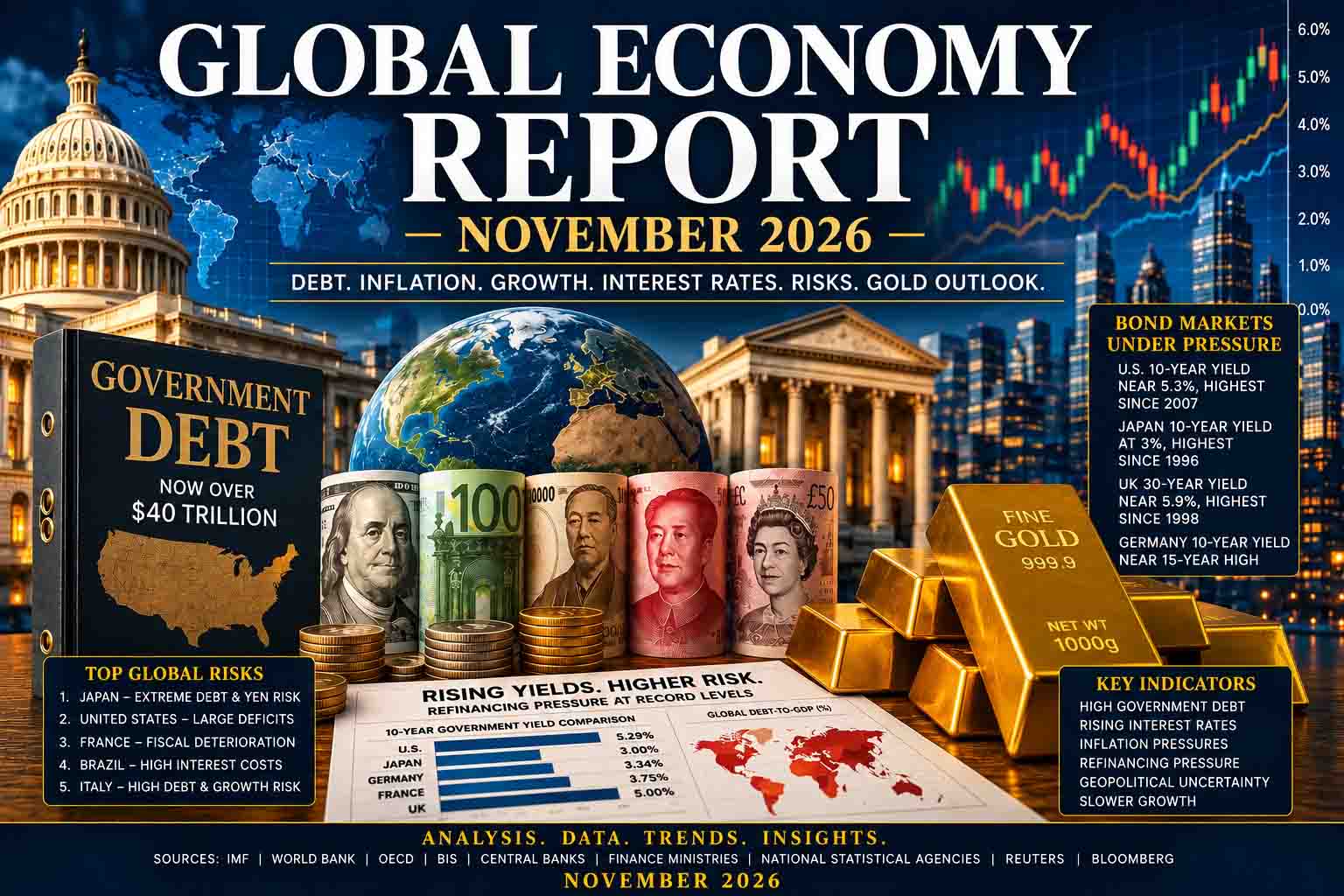
Reporting period: October 1–31, 2026 | Published: November 1, 2026
Executive assessment
The November edition examines whether the world’s leading economies are becoming more vulnerable to government debt, inflation, rising borrowing costs, and pressure on their currencies.
The central question remains: Can governments continue financing their accumulated debt without imposing increasingly expensive consequences on households, businesses, and public services?
This report follows the October edition, with particular attention to changes in central-bank policy, sovereign bond yields, fiscal deficits, refinancing requirements, and gold.
An important distinction governs the analysis: a country with high debt is not necessarily approaching default. Debt sustainability also depends on economic growth, the currency in which obligations are issued, the maturity of outstanding bonds, interest costs, government assets, and investors’ willingness to lend.
Similarly, central-bank policy rates and sovereign borrowing costs must be evaluated separately. A central bank can reduce its overnight interest rate while investors simultaneously demand higher yields on 10-year or 30-year government bonds.
Global growth and inflation: the new IMF forecast
2026 global GDP growth
3.1%
Up 0.1 percentage point from July forecast
2026 global headline inflation
4.7%
Expected to ease to 4.1% in 2027
The IMF’s October 13 World Economic Outlook, Resilience Under Strain, Urgent Choices, raised its 2026 global growth forecast from 3.0% to 3.1%, while retaining its 2027 projection of 3.4%.
The improvement is modest. The IMF identifies two competing economic forces: higher energy prices, which increase costs and suppress activity, and artificial intelligence investment, which supports business spending, trade, and productivity expectations. International Monetary Fund+2
This is an important distinction from the October report. The global economy has not weakened uniformly. Some technology-intensive sectors remain strong even as energy-dependent households and industries face increasingly difficult conditions.
Government debt and refinancing
OECD 2026 borrowing projections
$29 trillion
Government and corporate borrowing combined
$18 trillion
OECD central-government borrowing
78%
Share of sovereign borrowing used to refinance existing debt
$61 trillion
Outstanding OECD sovereign bonds at year-end 2025
Source: OECD Global Debt Report 2026. These are forecasts and debt-stock measures, not October-only borrowing figures. OECD+1
The OECD estimates that nearly four-fifths of government borrowing this year will refinance existing obligations. That matters because many maturing bonds were issued when interest rates were considerably lower.
The resulting budget pressure develops gradually. Governments do not ordinarily refinance their entire outstanding debt at once, but higher yields progressively increase interest expenditure as bonds mature.
The central fiscal question is whether economic growth and tax revenue can keep pace with those costs.
United States: Federal Reserve pauses, Treasury yields retreat
The Federal Reserve held its target range at 3.75%–4.00% on October 28, following its September increase.
The decision was not unanimous. Two policymakers preferred another quarter-point increase, reflecting continued concern about inflation. The Fed described economic activity as expanding strongly, with resilient domestic spending and robust capital investment. Federal Reserve issues FOMC statement+1
The more notable development occurred in the Treasury market.
U.S. 10-year Treasury yield
4.931%
October 30
Down from approximately 5.29% reported in late September.
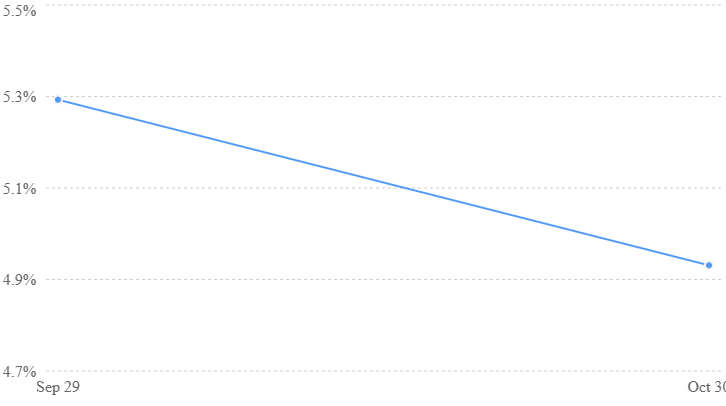
Late-September and October 30 reference observations, not daily closing series.
Reuters reported that the 10-year Treasury yield fell to 4.931% on October 30 as technology shares sold off and investors purchased government bonds. Reuters+1
This is a meaningful improvement in market borrowing conditions relative to late September, although yields remain elevated.
The decline does not resolve the structural U.S. deficit problem. It does demonstrate that government bond prices can recover during equity-market stress, even when fiscal concerns remain substantial.
November assessment: Very high structural fiscal risk; reduced immediate Treasury-yield pressure compared with late September.
Gold: the largest change in the report
Spot gold, October 30
$3,880.97/oz
−3.5% on the day
Lowest level since October 2025
Gold’s October performance materially weakened the short-term bullish case made by some sovereign-debt commentators.
Reuters reported that gold fell approximately 3.5% on October 30, alongside a technology-stock selloff and significant declines in silver, platinum, and palladium. Gold was approximately 30% below its January record of $5,595 per ounce. Reuters+1
Three mechanisms deserve attention.
First, a stronger dollar and elevated real yields reduce gold’s relative attractiveness because bullion pays no interest.
Second, sharp equity-market losses can force leveraged investors to sell liquid assets, including gold, to meet margin calls.
Third, central-bank purchases may provide longer-term support without preventing substantial short-term price declines.
The implication is important: government debt concerns alone do not establish that gold prices must rise.
GoldBroker.com’s precious-metals perspective remains relevant to the longer-term argument for diversification away from sovereign debt. However, as a commercial precious-metals business, its market interpretations should be distinguished from independently reported prices and official reserve statistics.
Confidence is high regarding October’s observed gold-price decline, but considerably lower regarding the timing or magnitude of any recovery.
Central-bank policy comparison
October brought a mixture of rate increases and pauses rather than a coordinated global policy change.
| Economy | Latest verified policy rate | October decision |
|---|---|---|
| United States | 3.75%–4.00% | Held |
| Euro area | 2.50% deposit rate | Held |
| Japan | 1.25% | Held |
| Canada | 2.50% | Raised 0.25 percentage point |
| United Kingdom | 3.75% | No October change verified |
The Bank of Canada delivered one of the month’s clearest policy changes, raising its overnight target from 2.25% to 2.50% on October 28. The bank also projected Canadian inflation could reach approximately 3.5% by year-end, while 2026 growth would be around 1%. Bank of Canada+1
The ECB held its deposit rate at 2.50% on October 29, warning that prolonged energy-price increases could weaken growth while keeping inflation above target. European Central Bank
Japan held at 1.25%, although one policymaker favored an additional increase. CME Group+1
Sovereign-risk assessment
The October developments warrant adjustments to the previous report’s risk judgments, particularly because U.S. Treasury yields declined while Canada’s monetary policy tightened.
| Rank | Economy | Risk assessment | Principal concern |
|---|---|---|---|
| 1 | Japan | Extreme | Very high public debt and monetary normalization |
| 2 | United States | Very high | Structural deficits and refinancing volume |
| 3 | France | Very high | Large deficits and euro-area borrowing costs |
| 4 | Brazil | Very high | High interest costs |
| 5 | Italy | Very high | Large debt stock and slow growth |
| 6 | United Kingdom | High | Inflation, gilts and weak fiscal flexibility |
| 7 | China | High | Local-government and property liabilities |
| 8 | India | Moderate-high | Oil imports, inflation and currency exposure |
| 9 | Canada | Moderate | Household leverage and renewed tightening |
| 10 | Russia | Mixed/high | War expenditure, sanctions and monetary pressure |
| 11 | South Korea | Moderate | Household debt and export dependence |
| 12 | Germany | Moderate-low | Weak growth and higher financing costs |
This is a provisional, qualitative ranking of combined fiscal and monetary vulnerability. It is not a sovereign-default probability ranking. The precise order of countries with different risk types is less certain than the broad risk categories.
The latest IMF Fiscal Monitor provides a reason to retain concern about public finances overall. Global public debt rose to approximately 94% of GDP in 2025 and is projected to reach 100% by 2029. The IMF also warns that increasingly leveraged participants in sovereign bond markets could amplify sudden repricing. IMF Connect+1
Consequences for households and governments
October’s developments have different implications for different groups.
For households, Canada’s rate increase and elevated U.S. borrowing costs reinforce pressure on mortgages and other credit. Higher energy costs also feed through transportation, food distribution, and household utility bills.
For businesses, the combination of high financing costs and large capital requirements for AI infrastructure raises the importance of earnings and cash flow. October’s technology-stock decline suggests investors are increasingly examining whether anticipated returns justify the enormous investment.
For governments, the OECD’s refinancing figures remain the central warning. Higher interest expenditure can eventually require some combination of higher taxes, spending restraint, faster economic growth, or additional borrowing.
For currencies, the outlook remains sensitive to differences in central-bank policy, trade balances, energy dependence, and investor confidence. Higher interest rates can support a currency, but only if investors believe the government’s broader financial position remains sustainable.
November watch list
The most important upcoming developments are the U.S. employment and inflation releases, the Federal Reserve’s December policy outlook, possible additional Bank of England tightening, and the durability of the late-October Treasury rally.
Oil prices also require close attention. Reuters reported Brent crude settling at approximately $117.63 per barrel on October 30. Sustained energy costs at that level would create continued pressure on inflation and the trade balances of energy-importing countries. Reuters
Gold’s behavior will be particularly revealing. A sustained recovery alongside falling real yields would suggest that monetary conditions are becoming more favorable. Continued weakness despite sovereign-debt concerns would suggest that interest-rate expectations, dollar strength, or investment liquidation remain dominant.
SBi Findings Summary
The November assessment differs from October in several important respects.
The IMF modestly improved its global growth forecast, the Federal Reserve paused rather than raising rates again, Canada resumed tightening, and U.S. long-term Treasury yields retreated from their late-September highs.
Gold, meanwhile, experienced a substantial selloff.
Those developments weaken the argument that global markets are moving in a single direction toward an immediate sovereign-debt crisis. They do not eliminate the underlying debt problem.
The IMF and OECD continue to identify rising public liabilities, unusually large refinancing requirements, and higher interest costs as structural vulnerabilities.
The central finding is that global economic resilience has continued, but maintaining that resilience is becoming more expensive.
Research limitations
This edition incorporates verified October IMF, OECD, central-bank, and Reuters findings. It does not constitute a completed 50-state newspaper audit: I have not verified a separate October search result from a leading newspaper in every state, so I cannot responsibly label those states as having produced no meaningful economic insight.
Likewise, the complete October IMF country-by-country debt and deficit dataset has not been extracted and reconciled here. The risk ranking is therefore provisional rather than a newly calculated statistical ranking. No specific October GoldBroker article was independently verified for inclusion.
The strongest findings are the new IMF global outlook, central-bank decisions, OECD refinancing estimates, U.S. Treasury movement, and October gold decline. Confidence is high on those observations, medium on the relative sovereign-risk rankings, and low on precise short-term forecasts for gold, currencies, and bond yields.
For the WordPress publication, I recommend keeping the title Global Economy Report — November 2026, while labeling the reporting period clearly as October 1–31, 2026.
Discover more from Rickey A. McElderry
Subscribe to get the latest posts sent to your email.