

Executive assessment
The global fiscal picture deteriorated during August, particularly in sovereign bond markets. The central problem is increasingly the interaction of four forces: enormous government refinancing needs, persistent inflation, higher long-term interest rates, and political difficulty reducing deficits.
The IMF still projects 3.0% global growth for 2026 and 3.4% for 2027, but raised its 2026 global headline-inflation forecast to 4.7%. The World Bank separately describes 2026 as the weakest global-growth environment since the pandemic, heavily influenced by the Middle East conflict, energy prices and borrowing costs. (IMF)
The OECD’s debt numbers illustrate the structural problem. Governments and corporations are expected to borrow approximately $29 trillion during 2026. OECD governments alone are projected to borrow around $18 trillion, while approximately $14 trillion of sovereign debt requires refinancing this year. Outstanding OECD sovereign bonds reached a record $61 trillion in 2025 and are projected to equal roughly 85% of GDP in 2026. (OECD)
Most importantly, roughly one-third of outstanding OECD fixed-rate debt matures between 2026 and 2028, while prevailing 10-year yields have recently been around two percentage points above the yields associated with maturing debt. The refinancing problem is therefore gradually migrating into government interest budgets. (OECD)
The major change since August: the bond market
This month’s strongest warning signal is not coming from GDP statistics. It is coming from government bonds.
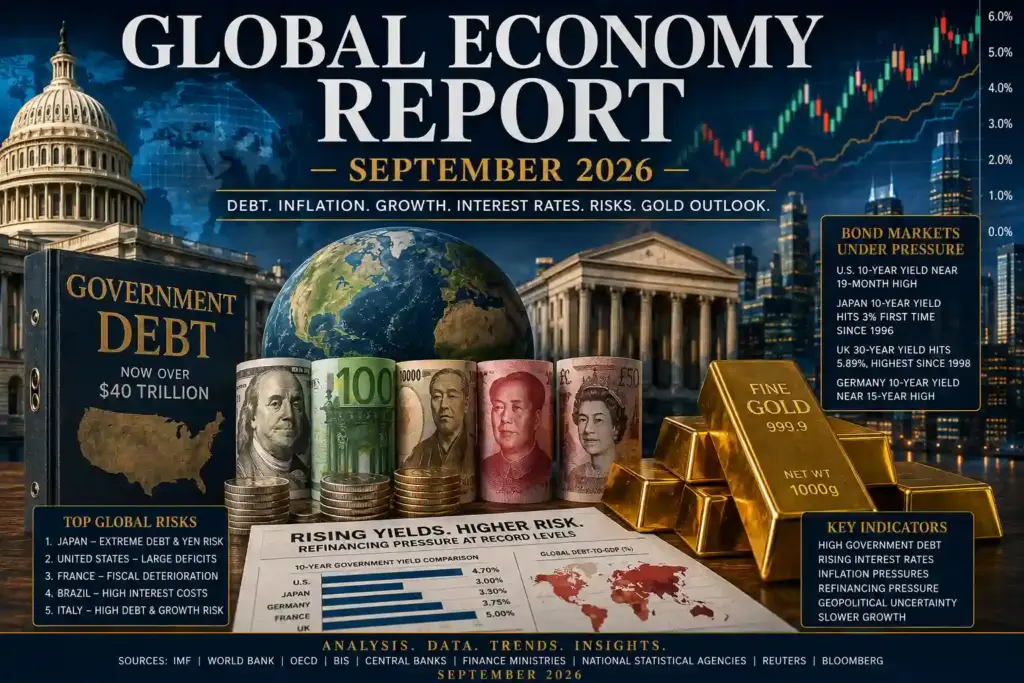
At the beginning of September, the U.S. 10-year Treasury yield reached its highest level in roughly 19 months. Japan’s 10-year yield reached 3% for the first time since 1996, Germany’s 10-year yield approached a 15-year high, and Britain’s 30-year gilt yield reached approximately 5.89%, its highest since 1998. (Reuters)
That development reinforces the OECD’s earlier warning that borrowers have increasingly shifted issuance toward shorter maturities because long-term financing has become expensive. Doing so saves money initially but increases refinancing risk because governments must return to the market more frequently. (OECD)
The BIS likewise reported divergence and renewed pressure across sovereign markets, with particularly significant movements in Japanese bonds and widening euro-area spreads as geopolitical and energy developments altered inflation and fiscal expectations. (Bank for International Settlements)
Confidence: High.
United States
The United States experienced the most consequential fiscal development of the month.
Federal debt passed $40 trillion in August, only months after passing $39 trillion. Meanwhile, Congressional Budget Office estimates cited in current reporting put this year’s federal deficit above $2 trillion. (Los Angeles Times)
Treasury yields continued climbing despite Treasury Secretary Scott Bessent announcing that the government would double certain long-duration Treasury buybacks to $4 billion per operation. The 10-year yield subsequently returned to roughly 4.7%, suggesting investors remain concerned about debt supply, inflation and competing corporate borrowing associated with AI infrastructure. (Los Angeles Times)
This is significant because the bond market is transmitting the federal fiscal problem directly to households. The Philadelphia Inquirer noted that 30-year mortgage rates had moved from below 6% before the Iran war to nearly 7%; on a $320,000 mortgage, that difference represents roughly another $210 per month. (Inquirer.com)
The Federal Reserve held its target rate at 3.50%–3.75% on July 29, but three voting members wanted a quarter-point increase. (Federal Reserve)
Since then, the inflation debate has moved in a more hawkish direction. U.S. manufacturing remained in expansion during August, but input-price pressures persisted, and markets entered September assigning substantial probability to another Fed increase. (Reuters)
September assessment
Fiscal risk: Very high and rising
Monetary risk: High
Immediate sovereign-default risk: Low
Long-term currency/inflation risk: Elevated
The United States still possesses enormous advantages: the world’s principal reserve currency, deep capital markets and the largest sovereign bond market.
But reserve-currency status does not eliminate arithmetic.
The crucial question is increasingly whether Treasury investors will continue financing enormous deficits at historically favorable real rates. August suggests investors are demanding greater compensation.
Japan
Japan remains the most structurally vulnerable large sovereign in this report.
The Bank of Japan is maintaining its overnight rate around 1.0%. (Bank of Japan)
That sounds extraordinarily accommodative compared with the United States or Britain, but Japan’s bond market is rapidly changing. Japanese yields have climbed sharply, with the 10-year government yield reaching 3% at the beginning of September.
This creates the dilemma highlighted in previous reports.
If Japan keeps monetary policy too loose, the yen can weaken and imported inflation can increase. If the BOJ tightens substantially, the financing cost of an enormous government debt stock rises.
GoldBroker’s August commentary emphasizes the same phenomenon from a precious-metals perspective, arguing that rising Japanese yields threaten assumptions underlying decades of cheap yen financing and carry trades. That is a commercially interested interpretation rather than neutral statistical evidence, but the underlying increase in Japanese yields is independently observable. (GoldBroker)
Risk: Extreme.
France and Italy
The ECB kept its deposit facility rate at 2.25%, main refinancing rate at 2.40%, and marginal lending facility at 2.65% in July. (European Central Bank)
The euro area’s problem is that a common interest rate affects countries with very different fiscal positions.
France remains particularly concerning because it combines large government debt, substantial deficits, weak growth and political constraints on fiscal consolidation.
GoldBroker reported in August that France’s 10-year yield had broken an important technical level and emphasized debt around 117.5% of GDP. Again, its interpretation should be treated as precious-metals commentary, but the underlying French fiscal deterioration deserves attention. (GoldBroker)
Italy’s absolute debt burden remains larger, but France’s direction of travel continues to make it the more interesting near-term euro-area sovereign-risk story.
France: Very high and rising.
Italy: Very high but comparatively stable.
United Kingdom
The Bank of England continues to hold Bank Rate at 3.75%. Current UK inflation is approximately 2.9%, above the 2% target. (Bank of England)
The bigger September story is the gilt market.
Britain’s 30-year government yield reached approximately 5.89% as September began, its highest since 1998, while the 10-year yield moved above 5%. (The Guardian)
Interestingly, investors recently pushed expectations for the next BOE rate increase into 2027. That produces a potentially uncomfortable situation: the central bank may not increase short-term rates soon, yet investors can still demand substantially higher long-term government borrowing rates. (Reuters)
That distinction is important throughout this report:
A central-bank policy rate is not the government’s borrowing cost.
Markets ultimately price sovereign bonds.
UK risk: High and rising.
China
China maintained the one-year Loan Prime Rate at 3.00% and five-year LPR at 3.50% in August for the 15th consecutive month. (Reuters)
The decision came despite weak domestic data, indicating that authorities currently prefer fiscal support and targeted measures rather than broad additional monetary easing.
China’s sovereign situation remains unusually difficult to compare with Western economies because headline central-government numbers omit much of the risk embedded in local-government financing vehicles, property development and state-linked enterprises.
China therefore remains a case where reported sovereign leverage understates broader public-sector financial exposure.
Formal sovereign risk: Moderate.
Hidden balance-sheet risk: Very high.
Brazil
Brazil delivered an important positive monetary development.
Its central bank reduced the Selic rate another 25 basis points on August 5 to 14.00%. (Reuters)
Nevertheless, 14% remains an extraordinarily restrictive interest rate.
Second-quarter GDP grew 0.5% quarter over quarter and 2.0% year over year, but household consumption declined 0.4%. Inflation remains above the central bank’s target. (Reuters)
Brazilian household finances are also becoming an important secondary risk. Household debt-service burdens reached record levels during June, prompting the central bank to consider tighter lending safeguards. (Reuters)
Risk: Very high, but monetary direction modestly improved.
South Korea
South Korea experienced one of the clearest monetary changes since the previous report.
The Bank of Korea raised its Base Rate from 2.75% to 3.00% on August 27, its second consecutive 25-basis-point increase. The bank cited stronger-than-expected growth, inflation expected to remain above target and continuing financial-stability risks. (한국은행)
That means South Korea has moved from 2.50% in May to 2.75% in July and now 3.00%.
The tightening illustrates a broader theme: the global easing cycle many investors anticipated has been disrupted by renewed inflation.
Sovereign fiscal risk: Moderate-low.
Private debt risk: Elevated.
Canada
The Bank of Canada remains at 2.25%. Its July assessment described the economy as weak but improving and projected inflation gradually returning toward 2%. (Bank of Canada)
Canada continues to look considerably healthier than the United States, France, Italy or Japan from a net-government-balance-sheet perspective.
Its larger vulnerabilities remain private:
housing prices, mortgage refinancing and household leverage.
Sovereign risk: Moderate.
Germany
Germany remains the strongest major Western sovereign in the comparison, but even Germany is no longer insulated from the global bond repricing.
Its 10-year government yield approached a 15-year high around 3.34% as September began. (The Guardian)
Germany therefore demonstrates an important point: rising yields are not exclusively punishment for fiscally weak governments. Inflation, energy costs, global capital competition and monetary expectations can raise financing costs even for relatively strong sovereign borrowers.
Risk: Moderate-low, but rising borrowing costs warrant attention.
Russia
Russia’s central bank reduced its key rate to 14.00% in July. It reported underlying inflation in roughly a 4%–5% annualized range while emphasizing continuing inflation expectations and fiscal risks. (Central Bank of Russia)
Russia’s low headline government debt remains misleading if interpreted as an overall measure of financial safety. War expenditure, sanctions, restricted capital-market access, inflation and institutional uncertainty remain dominant considerations.
Debt risk: Low.
Monetary/geopolitical risk: Extreme.
Updated risk ranking
| Rank | Economy | September risk | Change |
|---|---|---|---|
| 1 | Japan | Extreme | Worsening |
| 2 | United States | Very High | Worsening |
| 3 | France | Very High | Worsening |
| 4 | Brazil | Very High | Slight improvement |
| 5 | Italy | Very High | Stable |
| 6 | United Kingdom | High | Worsening |
| 7 | China | High | Stable |
| 8 | India | Moderate-High | Stable |
| 9 | Canada | Moderate | Stable |
| 10 | Russia | Mixed/High | Stable |
| 11 | South Korea | Moderate | Monetary risk rising |
| 12 | Germany | Moderate-Low | Slight worsening |
The ranking is a judgment of combined fiscal, refinancing, monetary, currency and financial-system risk, not a forecast that the highest-ranked countries will default.
Gold: August changed the picture
Gold had an exceptionally strong August before suffering a sharp reversal as the month ended.
Reuters reported that gold climbed roughly 10% by mid-August to around $4,400 an ounce, helped by renewed institutional and central-bank demand. (Reuters)
By late August, however, rising expectations for another Federal Reserve increase, higher Treasury yields and a stronger dollar began pressuring bullion. On September 1 gold fell more than 2% as U.S. Treasury yields surged. (Reuters)
This is precisely why the relationship between debt and gold should not be oversimplified.
Government fiscal deterioration can be bullish for gold over the long term because it encourages reserve diversification and concern about currency purchasing power.
But the same fiscal deterioration can drive bond yields higher. Higher real yields increase the opportunity cost of holding a non-interest-bearing asset such as gold and can therefore be bearish in the short term.
Gold is consequently caught between:
Fiscal distrust pushing it upward and higher real yields pushing it downward.
GoldBroker’s August analysis takes the more bullish side, arguing that declining foreign demand for Treasuries, sovereign-risk concerns and monetary intervention strengthen gold’s monetary role. Because GoldBroker operates commercially in precious metals, I regard this as a supplementary market thesis rather than neutral evidence. (GoldBroker)
Gold outlook: structurally constructive, tactically volatile.
Confidence: Medium-high.
What the 50-state newspaper sweep found
The requested search covered a major or popular publication associated with each of the 50 states. Automated access was blocked for many newspaper domains, so those states produced no independently accessible new economic insight for this run and are not being used to manufacture conclusions.
Where usable reporting was available, several themes stood out.
The Los Angeles Times reported both the crossing of the $40 trillion national-debt threshold and persistent Treasury-market pressure. It also reported Q2 U.S. growth of 1.5% annualized. (Los Angeles Times)
The Boston Globe independently highlighted the $40 trillion debt milestone, rising long-term Treasury yields and the resulting consequences for borrowing costs. (BostonGlobe.com)
The Philadelphia Inquirer supplied perhaps the most useful household-level translation of the bond-market problem: mortgage rates approaching 7% have materially increased monthly payments for ordinary homebuyers. (Inquirer.com)
Across the remaining state-paper searches, either access was blocked or the search produced no sufficiently meaningful new information beyond the national debt, inflation, energy-price, housing-affordability and interest-rate themes already captured above.
That negative result itself matters: I found no state-level reporting that overturns or materially alters the international fiscal-risk assessment.
Consequences for households
The sovereign debt story may sound abstract, but the transmission mechanism is becoming increasingly visible.
When governments borrow enormous amounts and investors demand higher yields, those yields become reference rates throughout the financial system.
That means higher:
- Mortgage payments
- Automobile financing
- Business borrowing
- Municipal financing
- Infrastructure costs
- Government interest expenditures
Governments eventually have fewer attractive choices. More revenue devoted to interest means less available for services unless taxes, borrowing or inflation increase.
This is why refinancing pressure matters even when a government can technically continue issuing debt.
Solvency is not the only risk. Affordability matters too.
What changed since the August report
Three developments deserve special attention.
First, the U.S. debt passed $40 trillion, while long-duration Treasury yields remained stubbornly high despite Treasury efforts to influence market conditions. (Los Angeles Times)
Second, the global bond selloff broadened. Japan, Britain and Germany are now demonstrating that higher sovereign borrowing costs are not solely an American problem. (Reuters)
Third, the monetary environment became more divided. Brazil cut to 14%, South Korea raised to 3%, the Fed held at 3.50%–3.75%, the ECB remained at 2.25%, Britain remained at 3.75%, and Japan stayed around 1%. (Reuters)
There is no longer a clean global easing cycle.
September 2026 watch list
The single most important number to monitor this month is the U.S. 10-year Treasury yield. If it remains elevated or moves decisively above recent highs while the Fed tightens, the fiscal and monetary problems begin reinforcing each other.
Japan’s 10-year yield is the second major signal. A sustained move around or above 3% fundamentally changes financing assumptions that prevailed in Japan for decades.
French spreads versus Germany deserve close observation, as does Britain’s long-duration gilt market.
Oil remains critical because another sustained rise would feed inflation precisely when central banks are debating whether rates are restrictive enough.
Gold should be watched alongside real yields rather than debt alone. A combination of worsening sovereign concerns and falling real rates would be particularly favorable for bullion; worsening sovereign concerns accompanied by sharply rising real yields creates a much more volatile environment.
September conclusion
The September report is more concerning than the August report.
Not because a sovereign crisis has begun—it has not—but because bond markets are increasingly forcing governments to confront the price of accumulated debt.
The OECD’s numbers explain why this matters. Approximately $14 trillion of OECD sovereign debt must be refinanced during 2026, while governments and corporations together are expected to raise roughly $29 trillion from markets. (OECD)
That creates competition for capital on an extraordinary scale.
The United States remains uniquely capable of financing itself, but the $40 trillion debt milestone, trillion-dollar-scale interest burden and persistent long-term yields make its fiscal trajectory one of the world’s central financial risks.
Japan remains the most structurally difficult sovereign because rising yields collide with a government debt burden above twice GDP.
France remains Europe’s most important deterioration story. Britain is experiencing increasingly expensive long-duration financing. Brazil is finally easing but remains burdened by extraordinary interest rates. China continues to conceal much of its fiscal risk outside conventional sovereign accounts.
Germany and South Korea remain comparatively strong.
The broader conclusion is therefore unchanged but stronger:
The world does not currently have a sovereign-debt crisis. It has a sovereign-debt refinancing problem that is becoming progressively more expensive.
The danger is not necessarily that governments suddenly become unable to borrow. It is that they can continue borrowing—but only at rates that gradually consume larger portions of national income and government revenue.
That is the mechanism worth watching during September 2026.
Overall confidence: High on the direction of sovereign refinancing and bond-market pressure; medium on country ordering beyond the highest-risk group; and low confidence in precise long-range market forecasts, particularly gold, currencies and future sovereign yields.
Discover more from Rickey A. McElderry
Subscribe to get the latest posts sent to your email.