
Black Laws, Racial Exclusion, and Citizenship: A 50-State Review of America’s State Constitutions
The history of race in America is written not only in the United States Constitution and federal law, but also in the constitutions, statutes, convention records, legislative journals, and archives of the individual states.
For this study, I reviewed historical state constitutional records, state archives, historical societies, legislative records, and federal sources looking for what were commonly called “Black Laws,” “Black Codes,” exclusion laws, white-only voting provisions, and laws restricting the civil rights of Black Americans.
One important distinction must be made at the beginning.
It would not be historically accurate to say that every state listed below wrote into its constitution that Black people could not be citizens. In many states, the constitutional language instead restricted voting, settlement, immigration, office-holding, jury service, testimony, education, militia service, property rights, or other rights normally associated with citizenship.
In some cases, Black people could legally be residents or citizens while being denied many of the rights white citizens possessed.
There were, however, governments that went considerably further. The 1836 Constitution of the independent Republic of Texas, for example, established citizenship while expressly excluding Africans and their descendants. Texas was not yet a U.S. state, so that document must be distinguished from a state constitution, but it remains one of the clearest examples of an American government expressly excluding people of African descent from citizenship itself.
Source: Texas State Library and Archives Commission
Jump to a State
Click any state to go directly to its historical findings.
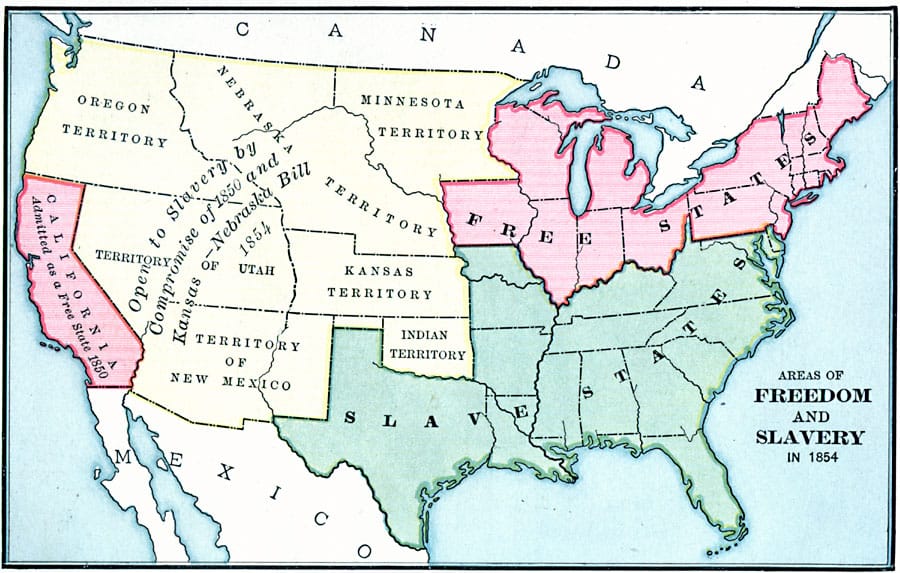
Black Laws Were Not Only a Southern Institution
One of the most important findings of this research is that racial exclusion was not confined to slave states or the former Confederacy.
Illinois, Indiana, Iowa, Ohio, Oregon, and other states that prohibited or restricted slavery nevertheless enacted laws designed to keep Black people out or deny Black residents equal civil and political rights.
A historical compilation of voting qualifications shows that by 1855, 25 of the nation’s 31 states had some form of racial exclusion in their voting laws, while New York imposed a special property qualification specifically upon men of color.
Source: Historical State Suffrage Table
Alabama
Finding: Explicit racial restriction on voting; later part of the Southern Black Code system.
Alabama’s early constitutional system restricted political participation by race. Historical voting records place Alabama among the states imposing a racial voting exclusion beginning with its 1819 Constitution.
This should not automatically be interpreted as a declaration that every free Black resident was legally a noncitizen. Rather, Black residents were denied important political rights granted to white male citizens.
Following emancipation, Alabama was also part of the broader Southern system of Black Codes and later Jim Crow restrictions.
Alaska
Finding: No comparable Black-specific state constitutional exclusion found in this review.
Alaska became a state long after the Reconstruction Amendments established federal constitutional protections concerning citizenship and race.
I found no provision comparable to Indiana’s Black settlement prohibition, Oregon’s Black exclusion clause, or the white-only voting provisions found in numerous nineteenth-century state constitutions.
This does not mean Alaska was free of racial discrimination. It means that I did not identify a Black-specific state constitutional exclusion comparable to the provisions examined elsewhere in this study.
Arizona
Finding: No comparable Black-specific state constitutional exclusion found.
Arizona entered statehood after the Fourteenth and Fifteenth Amendments were already part of the United States Constitution.
I found no comparable Black-specific citizenship prohibition, Black settlement ban, or founding white-only voting provision in its state constitution.
This finding concerns the specific constitutional question examined here and should not be interpreted as saying that racial discrimination never existed in Arizona.
Arkansas
Finding: Explicit racial restriction on voting; later Black Codes.
Arkansas adopted a racial exclusion from voting through its 1836 constitutional system.
As a former Confederate state, Arkansas later became part of the post-Civil War Southern legal system in which Black Codes attempted to restrict the freedom, labor, movement, and civil rights of formerly enslaved people.
California
Finding: White-only constitutional suffrage.
California entered the Union as a free state, but freedom from legal slavery did not mean racial equality.
Its original constitutional political system limited ordinary voting rights to white male citizens. Historical records identify California as imposing racial voting exclusion beginning around its admission to the Union in 1850.
California therefore belongs to an important category of states that rejected slavery but nevertheless withheld a fundamental political right from Black residents.
Colorado
Finding: No comparable Black-specific founding constitutional provision found.
Colorado became a state after adoption of the Fourteenth and Fifteenth Amendments.
In the materials examined for this study, I did not find a founding constitutional provision comparable to the earlier Black exclusion clauses or white-only voter provisions found in a number of nineteenth-century states.
Connecticut
Finding: Explicit white-only constitutional suffrage.
Connecticut’s 1818 Constitution contained unmistakable racial language.
Article Sixth, Section 2 provided voting eligibility to:
“Every white male citizen of the United States…”
who met the constitution’s other qualifications.
This was an explicit constitutional racial qualification for voting.
It also illustrates why citizenship and voting must be distinguished. The constitution did not simply declare that Black people could not exist as citizens. Instead, it reserved a central political privilege of citizenship to white men.
Delaware
Finding: Explicit white-only voting qualification.
The Delaware Public Archives records that the 1792 Constitution extended voting rights to free white men who met its age, residency, and tax requirements.
Delaware therefore incorporated race directly into political participation.
Source: Delaware Public Archives
Florida
Finding: Explicit racial voting exclusion; later Southern Black Codes.
Florida’s early state constitutional system limited political participation by race. Historical voting records identify a racial exclusion beginning with Florida’s statehood in 1845.
Following the Civil War, Florida also became part of the Southern system in which Black Codes attempted to regulate the labor, movement, and civil rights of freed Black Americans.
Georgia
Finding: One of the earliest explicit racial voting exclusions.
Georgia appears very early in the record. Its Revolutionary-era constitutional political system imposed a racial qualification upon voters.
Georgia later operated under an extensive slave-law system and, after the Civil War, became part of the Black Code and eventually Jim Crow systems that restricted Black civil and political rights.
Hawaii
Finding: No comparable Black-specific state constitutional exclusion found.
Hawaii became a U.S. state long after the Reconstruction Amendments.
I found no Black-specific constitutional citizenship prohibition or white-only suffrage provision comparable to those adopted by many nineteenth-century mainland states.
This finding should not be confused with Hawaii’s separate history of racial and ethnic discrimination.
Idaho
Finding: No comparable Black-specific founding provision found.
Idaho entered the Union after federal constitutional law prohibited states from denying voting rights because of race.
I found no equivalent of Indiana’s Black settlement clause, Oregon’s exclusion provision, or the earlier white-only electorate provisions examined in this article.
Illinois
Finding: One of the clearest Northern examples of Black Laws and racial exclusion.
Illinois deserves special attention because it was legally a free state yet developed one of America’s most extensive systems of Black Laws.
The Illinois State Archives reports that the legislature enacted its first Black Laws in 1819. These measures denied free African Americans basic rights of citizenship, restricted Black immigration into Illinois, and prohibited Black residents from serving on juries or in the militia.
The 1848 Illinois Constitution required the legislature to prohibit African Americans from moving into Illinois.
In 1853 the legislature enacted an especially harsh Black Law prohibiting Black migration into the state.
A Black person entering Illinois could be ordered to leave, fined, and—if unable to pay the fine—have his or her labor sold by the county sheriff.
The Illinois State Archives describes the 1853 measure as among the harshest Black Laws enacted by a Northern state.
Most of these laws were finally repealed in 1865.
Illinois provides powerful evidence that legalized racial exclusion was not simply a Southern phenomenon.
Source: Illinois State Archives
Indiana
Finding: Explicit constitutional prohibition on Black settlement.
Indiana contains one of the clearest constitutional examples discovered during this research.
Indiana’s 1851 Constitution, Article XIII, declared:
“No negro or mulatto shall come into or settle in the State, after the adoption of this Constitution.”
Indiana also denied Black men voting rights.
This went considerably beyond refusing Black men the ballot. Indiana wrote a racial settlement prohibition directly into its state constitution.
Indiana was legally a free state.
Yet its constitution attempted to prevent additional Black people from settling there.
Source: Indiana Historical Bureau
Iowa
Finding: Extensive Black Laws, voting restrictions, and a statutory Black settlement prohibition.
Iowa’s record is especially significant because it entered the Union as a free state.
The State Historical Society of Iowa acknowledges that African Americans were nevertheless subjected to open legal discrimination.
Black Iowans were denied the right to vote, testify in court, serve in the state militia, practice law, and attend public schools.
In 1851, Iowa enacted a law prohibiting Black settlement in the state.
According to the State Historical Society of Iowa, the law appears to have been enforced only once, in Keokuk in 1856, where Black residents resisted its enforcement.
Iowa therefore joins Illinois and Indiana as major examples of racial exclusion in the antebellum Midwest.
Source: State Historical Society of Iowa
Kansas
Finding: Original white-only electorate; voters rejected removing “white” in 1867.
Kansas’s constitutional amendment history contains a revealing record.
In 1867, Kansas voters were asked whether the word “white” should be removed from the constitutional qualifications for an elector.
The proposal failed:
For removal: 10,483
Against removal: 19,421
A majority therefore voted to retain the racial qualification.
Racial language also appeared in Kansas’s militia provisions. A later proposal removing racial language from that section was approved.
Kentucky
Finding: Explicit racial voting exclusion.
Kentucky’s constitutional history established a race-based voting restriction in its early constitutional political system.
Kentucky also maintained slavery and significant legal restrictions upon free Black people.
For purposes of this study, Kentucky’s constitutional provision is best described as a racial suffrage restriction rather than a literal declaration that no Black person could be a citizen.
Louisiana
Finding: Explicit racial voting exclusion; later Black Codes.
Louisiana adopted racial restrictions on political participation through its early constitutional system.
The state later became part of the Southern Black Code system following emancipation.
Those postwar laws were designed to restrict Black political, economic, and personal freedom even after slavery itself had ended.
Maine
Finding: No comparable race-specific voting exclusion identified in the early state constitution reviewed.
Maine stands apart from many states admitted during the early nineteenth century.
It does not appear in the historical chronology of states imposing the same explicit race-specific voting exclusions found elsewhere.
This does not establish that racial prejudice or discriminatory treatment was absent from Maine. It means that I did not identify a comparable constitutional white-only suffrage or Black-settlement provision in the records examined for this study.
Maryland
Finding: Racial voting exclusion first by statute and then constitutionally.
Maryland is particularly useful because the historical record distinguishes between statutory and constitutional exclusion.
A racial voting restriction was imposed through legislation and subsequently embedded within Maryland’s constitutional framework.
This demonstrates how racial discrimination could begin in ordinary legislation and later become part of a state’s constitutional structure.
Massachusetts
Finding: A proposed white-only constitutional clause was rejected; the ratified 1780 Constitution contained no racial voting restriction.
Massachusetts provides an important contrast to many other states.
A proposed 1778 constitution would have restricted voting to white males. Massachusetts towns rejected that constitution, and some protested the racial exclusion.
The successful 1780 Massachusetts Constitution contained no voting restriction expressly based upon race, although voting was still restricted by sex and property qualifications.
Massachusetts was therefore not politically equal in the modern sense, but its ratified constitution did not contain the same white-only voter language found in many states.
Source: Massachusetts Secretary of the Commonwealth
Michigan
Finding: Explicit constitutional racial voting restriction.
Michigan’s original constitutional political system restricted voting primarily to white males.
Like several other Northern free states, Michigan prohibited slavery while simultaneously refusing equal political rights to Black residents.
Minnesota
Finding: The 1857 Constitution restricted voting by race, and attempts to remove the barrier failed twice.
Modern Minnesota legislative records acknowledge this history.
The Minnesota Legislature has stated that the 1857 state constitution limited voting to white residents and certain Native American voters.
Proposals to extend suffrage to Black residents were rejected in 1865 and again in 1867.
Nonwhite men finally received voting rights in Minnesota in 1868.
This is particularly significant because it represents a modern state government’s acknowledgment of its own discriminatory constitutional history.
Mississippi
Finding: Explicit racial voting exclusion and birthplace of the first statewide post-Civil War Black Codes.
Mississippi restricted Black political participation through its antebellum constitutional system.
After emancipation, Mississippi became one of the most important states in the history of the Black Codes.
The National Park Service records that Black citizens were excluded from Mississippi’s 1865 constitutional convention and that the new political order failed to provide meaningful civil-rights protections.
The legislature subsequently enacted what the National Park Service identifies as the first statewide postwar Black Codes.
Missouri
Finding: Racial political exclusion, extensive Black regulation, and restrictions upon free Black migration and settlement.
Missouri’s state archives contain extensive records concerning laws regulating both enslaved and free Black people.
The Missouri Secretary of State reports that the state’s early General Assembly enacted measures regulating free Black residents and abolitionists, building upon earlier colonial Black Codes.
Missouri also restricted free Black migration and settlement and required free Black residents to comply with special documentation requirements.
Missouri’s history therefore includes both political exclusion and a broad statutory system regulating Black life and movement.
Source: Missouri Secretary of State
Montana
Finding: No comparable Black-specific founding constitutional exclusion found.
Montana entered the Union after the Fourteenth and Fifteenth Amendments had fundamentally changed federal citizenship and voting law.
I found no Black-specific settlement prohibition or founding white-only constitutional suffrage clause comparable to those found in earlier states.
Nebraska
Finding: White-only voting provision proposed, but Congress required its removal as a condition of statehood.
Nebraska presents an unusual case.
The Nebraska State Historical Society reports that the constitution submitted during Nebraska’s struggle for statehood restricted voting to white males.
Congress refused to admit Nebraska unless the racial restriction was removed.
Nebraska accepted the condition, and statehood followed in 1867.
Nebraska therefore attempted to enter the Union with a racially restrictive voting system, but the federal government prevented that restriction from remaining the operative condition for admission.
Nevada
Finding: Original constitutional suffrage included racial restrictions.
Nevada’s early constitutional framework contained racial qualifications within its political system.
It should therefore be classified among states whose original political structure included racial restrictions—not necessarily as a state declaring all Black residents noncitizens, but as one denying equal political rights.
New Hampshire
Finding: No comparable explicit race-specific constitutional voting restriction identified.
New Hampshire’s early voting system imposed qualifications involving such matters as sex, property, and taxation.
However, I did not identify the same explicit constitutional use of “white” as a voter qualification found in states such as Connecticut, Georgia, and West Virginia.
New Jersey
Finding: Black voting rights existed early and were later taken away.
New Jersey demonstrates that American voting rights did not expand in a straight line.
Its early constitutional language did not initially restrict voters expressly by race.
But in 1807, New Jersey imposed a racial and gender exclusion through statute, restricting voting to white men.
The racial restriction was subsequently incorporated into the state’s later constitutional political structure.
Thus some free Black New Jersey residents who had previously possessed voting rights were disenfranchised.
New Mexico
Finding: No comparable Black-specific state constitutional exclusion found.
New Mexico became a state after both the Fourteenth and Fifteenth Amendments were firmly embedded in federal constitutional law.
I found no founding state constitutional provision comparable to the antebellum white-only voting clauses or Black settlement exclusions examined elsewhere.
New York
Finding: Black men could be citizens but were subjected to a special discriminatory voting standard.
New York provides one of the clearest examples of why citizenship and voting must not be treated as identical concepts.
During the nineteenth century, New York removed major property qualifications for many white male voters while maintaining a special, much higher property qualification for Black men.
New York therefore did not simply declare Black men to be noncitizens.
Instead, it constructed a separate and substantially more difficult path to exercising the vote because of their race.
North Carolina
Finding: Free Black migration was restricted, and Black voting rights were constitutionally removed in 1835.
North Carolina’s own General Assembly has formally acknowledged the state’s long history of government-sanctioned racial discrimination.
Historical records show that North Carolina restricted the entry of free Black people.
The 1835 Constitution also removed voting rights from free Black men.
This is another example of a state taking political rights away from Black residents who previously possessed them.
Source: North Carolina General Assembly
North Dakota
Finding: No comparable Black-specific founding constitutional exclusion found.
North Dakota entered the Union after the Reconstruction Amendments had established federal protections involving citizenship and race.
I found no Black-specific constitutional citizenship or settlement prohibition comparable to the earlier nineteenth-century exclusion laws.
Ohio
Finding: White-only suffrage and influential Northern Black Laws.
Ohio was another free state that nevertheless developed an extensive system of racial restrictions.
Ohio’s early political system restricted voting by race.
The state’s early Black Laws also required Black residents to satisfy special registration and documentation requirements and restricted important civil rights.
Ohio therefore belongs with Illinois, Indiana, and Iowa in demonstrating that opposition to slavery did not necessarily mean support for Black equality or Black settlement.
Oklahoma
Finding: Formal segregation was initially kept out of the state constitution, but Jim Crow followed immediately; a discriminatory constitutional grandfather clause came later.
Oklahoma entered the Union after the Fifteenth Amendment, making an explicit white-only electorate constitutionally problematic.
The Oklahoma Historical Society reports that segregation provisions were deliberately kept out of the state constitution because President Theodore Roosevelt would not approve such a constitution.
But immediately following statehood, Oklahoma lawmakers enacted Senate Bill No. 1, establishing Jim Crow segregation.
Then, in 1910, Oklahoma adopted the infamous constitutional “grandfather clause.”
The mechanism made voting considerably more difficult for African Americans while protecting many white voters from the same restrictions.
The United States Supreme Court struck the provision down in Guinn v. United States in 1915.
Oklahoma demonstrates how racial disfranchisement evolved after explicit racial voting prohibitions became unconstitutional.
Source: Oklahoma Historical Society
Oregon
Finding: One of the strongest constitutional Black exclusion systems in the United States.
Oregon is one of the most striking discoveries in this study.
The Oregon Secretary of State records that at the 1857 Constitutional Convention, delegates drafted a constitution that prohibited slavery while simultaneously barring African Americans from residency and restricting voting by race.
Oregon entered the Union in 1859 carrying this exclusionary constitutional history.
This is extraordinarily important.
Oregon opposed slavery but did not respond by establishing racial equality.
Its constitutional approach effectively attempted to establish a state with neither slavery nor additional Black settlement.
Source: Oregon Secretary of State
Pennsylvania
Finding: Black men who once possessed voting rights were constitutionally disenfranchised.
Pennsylvania’s earlier constitutions used language such as “freemen” rather than an explicit white racial qualification.
That changed in 1838, when Pennsylvania adopted an explicit racial voting restriction.
The result was particularly significant because Black men who had previously participated politically were stripped of that right.
Pennsylvania therefore provides another example in which racial political restrictions became more severe during part of the nineteenth century.
Rhode Island
Finding: Severe property and political restrictions, but no comparable explicit race-worded constitutional exclusion identified in this review.
Rhode Island maintained an extremely restrictive early voting system based heavily upon property ownership.
However, I did not identify the same constitutional white-only language found in a number of other early states.
This should not be interpreted as proof of complete racial equality. Black Rhode Islanders still encountered prejudice and discrimination.
The constitutional mechanism, however, differed from explicit white-only clauses found elsewhere.
South Carolina
Finding: Explicit white political system; slavery, Black Codes, and later Jim Crow.
South Carolina was among the earliest states to make race a central qualification for political participation.
Its constitutional voting structure restricted suffrage to white men.
After the Civil War, South Carolina enacted discriminatory Black Codes.
During Congressional Reconstruction, the state was required to reconstruct its government, eventually opening political participation to Black men.
South Dakota
Finding: No comparable Black-specific founding constitutional exclusion found.
South Dakota entered the Union after the Fourteenth and Fifteenth Amendments had changed the nation’s constitutional system.
I found no founding Black citizenship ban, settlement prohibition, or white-only voting provision comparable to those found in earlier states.
Tennessee
Finding: Black voting rights were removed in 1834.
Tennessee’s earlier political system did not initially contain the same absolute racial voting exclusion found in several neighboring states.
That changed with the 1834 Constitution, when Tennessee adopted a racial voting restriction.
Tennessee therefore provides another example of a state moving backward: free Black men who had previously been legally capable of voting were disfranchised.
Texas
Finding: The strongest direct citizenship exclusion discovered occurred under the independent Republic of Texas, followed later by white-only state suffrage.
The Republic of Texas
Texas requires an important historical distinction.
The Texas State Library and Archives Commission records that the 1836 Constitution of the Republic of Texas established citizenship while expressly excluding:
“Africans, the descendents of Africans, and Indians excepted.”
This goes beyond a simple voting restriction.
It is direct citizenship language.
However, accuracy requires emphasizing that Texas was an independent republic in 1836 and was not yet a state of the United States.
The State of Texas
After annexation into the United States, Texas’s state constitutional system restricted voting by race.
Following the Civil War, Texas also became part of the broader Southern system of Black Codes and later Jim Crow laws.
Source: Texas State Library and Archives Commission
Utah
Finding: No comparable Black-specific state constitutional exclusion found at statehood.
Utah entered the Union after the Fourteenth and Fifteenth Amendments had established federal citizenship and prohibited racial voting exclusions.
In the materials reviewed, I found no constitutional Black settlement prohibition or white-only electorate comparable to those found in earlier nineteenth-century states.
Vermont
Finding: No comparable explicit race-based constitutional suffrage exclusion identified.
Vermont stands among the relatively small number of early states that did not use the same explicit race-specific voter language identified elsewhere in this survey.
Its early constitutional tradition used broader terminology concerning freemen.
This should not be interpreted as proving that Black residents experienced complete social or legal equality.
The important finding is that I did not identify a Vermont provision comparable to the explicit white-only electorate clauses of many other states.
Virginia
Finding: One of America’s earliest racial suffrage restrictions.
Virginia’s racial voting restrictions predated the establishment of the United States.
Its colonial and Revolutionary-era political systems restricted political participation along racial lines.
Virginia’s slave laws also subjected both enslaved and free Black people to extensive legal restrictions.
Southern Black laws commonly prohibited or restricted Black voting, office-holding, testimony, movement, and other civil rights.
Washington
Finding: No comparable Black-specific founding state constitutional exclusion found.
Washington became a state after the Fourteenth and Fifteenth Amendments had established federal protections concerning citizenship and race.
I found no Black-specific citizenship prohibition, Black settlement exclusion, or founding white-only electorate provision comparable to the earlier states examined in this study.
West Virginia
Finding: Explicit white-only voting provision in the original 1863 Constitution.
West Virginia’s original state constitution provides unmistakable evidence.
Article III declared:
“The white male citizens of the State shall be entitled to vote…”
The same constitutional structure connected political office with voting eligibility, extending the practical consequences of racial exclusion beyond the ballot itself.
This is another example where the most accurate description is not necessarily that every Black resident was declared a noncitizen, but that the constitution denied Black residents fundamental political rights because of race.
Source: West Virginia Archives and History
Wisconsin
Finding: Original state constitutional suffrage restricted to white males.
Wisconsin entered the Union as a free state, yet its original 1848 Constitution restricted ordinary political suffrage by race.
Wisconsin therefore belongs among the Northern free states that prohibited slavery while initially refusing equal political rights to Black men.
Wyoming
Finding: No comparable Black-specific state constitutional exclusion found.
Wyoming entered the Union after federal constitutional law prohibited states from denying citizens the vote because of race.
I found no Black-specific citizenship prohibition or Black exclusion clause comparable to those found in Indiana, Oregon, Illinois, Iowa, or the earlier white-only suffrage states.
What the 50-State Record Actually Shows
1. A Literal Ban on Black Citizenship Was Less Common Than Denying the Rights of Citizenship
This distinction matters.
A state constitution or statute could recognize or tolerate the existence of free Black residents while denying those people the vote, jury service, public office, militia service, education, court testimony, property rights, freedom of settlement, or other legal protections.
In practical terms, a person could therefore be called “free” while possessing only a fraction of the rights enjoyed by a white neighbor.
The 1836 Republic of Texas Constitution is one of the clearest examples found in this study of an actual racial citizenship exclusion.
2. Voting Was the Most Common Constitutional Racial Barrier
By the middle of the nineteenth century, a large majority of states then in the Union imposed some form of racial limitation upon political participation.
The states appearing in the historical racial-suffrage record include Alabama, Arkansas, California, Connecticut, Delaware, Florida, Georgia, Illinois, Indiana, Iowa, Kentucky, Louisiana, Maryland, Michigan, Mississippi, Missouri, New Jersey, North Carolina, Ohio, Pennsylvania, South Carolina, Tennessee, Texas, Virginia, and Wisconsin.
New York used a different but still discriminatory system by imposing a special property requirement on Black men.
3. The North Had Black Laws Too
One of the most important lessons from state archives is that being a “free state” did not necessarily mean welcoming Black citizens.
Illinois enacted Black Laws and eventually prohibited Black migration.
Indiana placed a prohibition against Black settlement directly into its 1851 Constitution.
Iowa enacted an 1851 law prohibiting Black settlement while denying Black residents voting, court testimony, militia service, law practice, and access to public schooling.
Oregon prohibited slavery while simultaneously building racial exclusion into its constitutional system.
These records make it impossible to describe racial exclusion simply as a Southern institution.
4. Some States Actually Took Rights Away From Black People
The history was not a steady march toward equality.
New Jersey restricted voting after some Black residents had previously participated politically.
Tennessee disfranchised free Black men in 1834.
Pennsylvania imposed racial exclusion in 1838.
Minnesota voters rejected attempts to extend Black suffrage in both 1865 and 1867.
Political rights could therefore be possessed, removed, and later restored.
5. Oregon and Indiana Stand Out for Constitutional Black Exclusion
Many constitutions reserved voting to whites.
Indiana and Oregon went considerably further.
Indiana’s 1851 Constitution declared that no Black or mixed-race person could newly come into the state and settle there.
Oregon’s constitutional convention created a state that prohibited slavery while simultaneously attempting to prevent Black settlement and limiting political participation by race.
These were not merely voting qualifications.
They were attempts at geographical racial exclusion.
6. Illinois and Iowa Stand Out Among Northern Black Law Systems
The Illinois State Archives openly uses the term “Black Laws” and acknowledges that those laws denied free African Americans basic rights of citizenship.
The State Historical Society of Iowa likewise acknowledges that Iowa denied Black residents voting and numerous civil rights while also enacting legislation prohibiting Black settlement.
These are not accusations made only by modern commentators.
They are documented in the historical records maintained by the states themselves.
The Fourteenth Amendment Changed the Meaning of Citizenship
The constitutional turning point came after the Civil War.
The Fourteenth Amendment, ratified in 1868, declared:
“All persons born or naturalized in the United States, and subject to the jurisdiction thereof, are citizens of the United States and of the State wherein they reside.”
It also prohibited states from abridging the privileges or immunities of United States citizens and required due process and equal protection of the laws.
Source: National Archives — Fourteenth Amendment
That language fundamentally changed the constitutional basis upon which states could define or deny citizenship.
The Fifteenth Amendment Attacked the White-Only Ballot
Citizenship alone did not guarantee voting rights.
That required another constitutional change.
The Fifteenth Amendment, ratified in 1870, declared that the right of United States citizens to vote could not be denied or abridged because of:
“race, color, or previous condition of servitude.”
Source: National Archives — Fifteenth Amendment
That made explicit white-only voting provisions constitutionally unenforceable.
But racial disfranchisement did not disappear.
Instead, many states replaced openly racial language with mechanisms that appeared racially neutral on paper: literacy tests, poll taxes, complicated registration requirements, grandfather clauses, white primaries, intimidation, and violence.
Oklahoma’s grandfather clause illustrates this transition particularly well.
Black Codes After Emancipation
The abolition of slavery did not immediately produce freedom in practice.
In 1865 and 1866, Southern governments began passing laws that became widely known as Black Codes.
These laws regulated or restricted employment, movement, contracts, property, weapons, jury service, court testimony, and political participation.
Some vagrancy laws allowed Black citizens who could not prove employment to be arrested and placed into coercive labor arrangements.
The National Park Service describes the Black Codes as efforts to restrict the rights of freedpeople and preserve major elements of the old plantation labor system after slavery.
Congressional Reconstruction, federal civil-rights legislation, and the Reconstruction Amendments attempted to dismantle this system.
But the collapse of Reconstruction was followed by another generation of racial restrictions under Jim Crow.
Final Assessment
The historical record does not support the statement that every American state constitution banned Black people from becoming citizens.
But what the records reveal is more complicated—and in many cases nearly as consequential.
A large majority of states existing before the Civil War imposed racial restrictions upon voting.
Some Northern states enacted laws intended to discourage or completely prevent Black settlement.
Some states prohibited Black people from serving on juries, testifying against whites, serving in militias, attending public schools, practicing professions, voting, holding office, or freely entering the state.
Some wrote the word “white” directly into their constitutional qualifications for voters.
Indiana constitutionally attempted to stop additional Black people from settling within its borders.
Oregon prohibited slavery while simultaneously constructing a constitutional system designed to exclude Black settlement and restrict political participation by race.
Illinois developed what its own State Archives identifies as an extensive system of Black Laws.
Iowa—although admitted as a free state—prohibited Black settlement while denying Black residents numerous civil and political rights.
And before Texas became a state, the Republic of Texas went further still by expressly excluding Africans and their descendants from its constitutional citizenship provision.
The historical lesson is therefore larger than slavery alone.
American law repeatedly separated the ideas of being free, being a resident, being a citizen, and possessing the full rights of citizenship.
A person could be legally free yet prohibited from voting.
A person could live in a state yet be denied the right to testify in court.
A Black child could be born on American soil yet grow up under a state government that denied his family meaningful political participation.
A state could prohibit slavery while simultaneously passing laws designed to keep Black people from entering it.
That is what the surviving constitutions, statutes, legislative records, historical societies, and state archives reveal.
A Note About This Research
This article is a 50-state historical survey. It should not be interpreted as a claim that every discriminatory statute ever enacted by every state, territory, county, city, or municipality has been catalogued here.
When a state is identified as having “no comparable Black-specific constitutional provision found,” that means I did not identify in the constitutional and archival material examined a provision comparable to the white-only voting clauses, Black settlement prohibitions, or direct racial citizenship restrictions discussed elsewhere in the article.
It does not mean that racial discrimination, segregation, discriminatory court decisions, discriminatory local ordinances, or private racial violence never occurred in that state.
I have also deliberately separated citizenship from voting rights.
Historically, those were not the same legal question.
The distinction matters because the evidence is powerful enough without exaggerating it.
The Fourteenth Amendment established that persons born or naturalized in the United States are citizens of both the United States and the state in which they reside.
The Fifteenth Amendment prohibited governments from denying voting rights on account of race, color, or previous condition of servitude.
Those amendments were necessary in large part because the historical state records examined above show how extensively racial distinctions had already been written into American law.
Discover more from Rickey A. McElderry
Subscribe to get the latest posts sent to your email.