
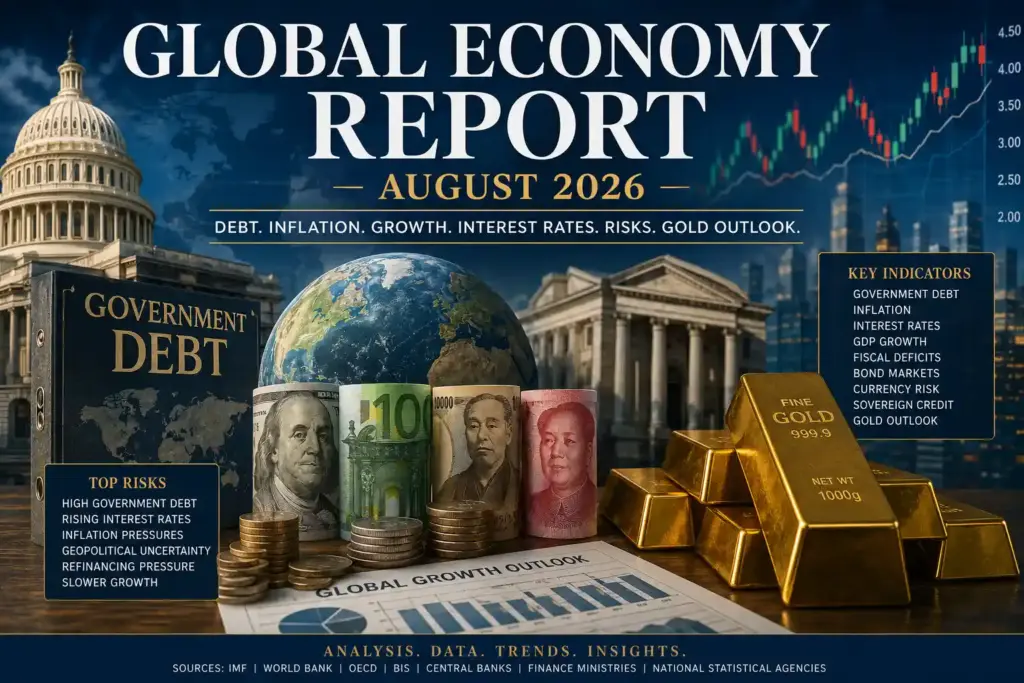
Global Economy Shows Growing Signs of Financial Strain
The global economy entered August facing slower growth, persistent inflation, record government borrowing, and rising long-term interest rates. While the world is not yet experiencing a sovereign debt crisis, the financial foundations supporting many governments continue to weaken.
According to the International Monetary Fund (IMF), global growth is expected to remain near 3% during 2026, while the World Bank projects approximately 2.5% growth using its own methodology. Both institutions cite elevated public debt, geopolitical instability, inflation, and higher energy costs as the primary threats to economic stability.
The most significant development during July was the sharp rise in government bond yields across several major economies. Investors are demanding higher returns to lend money to governments that continue running large budget deficits.
The central concern is no longer simply how much debt governments have accumulated. It is the combination of enormous debt, persistent annual deficits, rising refinancing costs, and investors becoming less willing to finance unlimited borrowing at low interest rates.
Leading Economies at a Glance
| Country | Debt-to-GDP | Policy Rate | Growth Outlook | Primary Risk |
|---|---|---|---|---|
| Japan | 204.4% | 1.00% | 0.7% | Extremely high debt and weakening yen |
| Italy | 138.4% | 2.25% | Under 1% | Very high debt burden |
| United States | 125.8% | 3.50%–3.75% | 1.5–2.0% | Large deficits and refinancing costs |
| France | 118.4% | 2.25% | Under 1% | Fiscal deterioration |
| Canada | 110.7% | 2.25% | 1.5% | Housing and household debt |
| China | 106.9% | 3.00% | 4.0% | Property and local government debt |
| United Kingdom | 103.6% | 3.75% | About 1% | Inflation and weak growth |
| Brazil | 96.5% | 14.25% | About 2% | Extremely high borrowing costs |
| India | 83.4% | 5.25% | 6.5–6.7% | Oil dependence |
| Germany | 64.6% | 2.25% | 0.8% | Weak economic growth |
| South Korea | 54.4% | 2.75% | About 2% | Household debt |
| Russia | 19.1% | 14.00% | Low to moderate | War spending and sanctions |
United States
The United States continues to carry one of the world’s largest debt burdens, with IMF general government debt estimated at approximately 126 percent of GDP.
Federal budget deficits remain near 6 percent of GDP even though the economy is not in recession. Rising Treasury yields have significantly increased borrowing costs, and annual federal interest payments are approaching one trillion dollars.
Key Risks
- Large structural budget deficits
- Rising Treasury refinancing costs
- Increasing interest payments
- Persistent inflation pressure
Although the United States benefits from issuing the world’s primary reserve currency, that advantage cannot indefinitely offset rapidly rising debt and deficits.
Japan
Japan remains the world’s most indebted major economy, with government debt exceeding 200 percent of GDP.
During July, the Japanese yen weakened to levels not seen in decades, forcing reported currency intervention by Japanese authorities.
Japan now faces a difficult choice between keeping interest rates low to support government finances or raising rates to strengthen the currency at the expense of much higher debt servicing costs.
France
France has become one of Europe’s fastest-growing fiscal concerns.
Government debt now exceeds 118 percent of GDP while budget deficits remain among the highest in the euro area. French government bond yields rose sharply during July, reflecting growing investor concerns regarding future borrowing needs.
Italy
Italy continues to carry one of Europe’s highest debt burdens.
Although fiscal management has modestly improved, Italy remains vulnerable to higher European Central Bank interest rates, weak long-term economic growth, and political uncertainty.
China
China’s official government debt exceeds 100 percent of GDP, but many economists believe the country’s actual obligations are significantly larger once local governments, state-owned enterprises, and property-related liabilities are included.
China maintains considerable financial flexibility because much of its debt is financed domestically through state-controlled banks.
United Kingdom
The United Kingdom continues facing a difficult combination of slow growth, inflation, and elevated government debt.
Higher government bond yields have increased borrowing costs while inflation remains above the Bank of England’s target.
Brazil
Brazil currently has one of the world’s most expensive debt structures.
Although government debt is lower than several advanced economies, Brazil’s policy interest rate of 14.25 percent makes servicing that debt extremely expensive.
India
India remains the fastest-growing major economy.
Strong economic expansion continues to improve the country’s long-term outlook, although higher oil prices and inflation remain important risks.
Canada
Canada’s government debt appears relatively high using gross debt measurements, but its net debt position is considerably stronger due to government financial assets and pension funds.
The country’s greatest vulnerabilities remain housing affordability and household debt.
Germany
Germany retains one of the strongest fiscal positions among advanced economies.
While economic growth remains sluggish, Germany still possesses substantially greater fiscal flexibility than most Western nations.
South Korea
South Korea maintains relatively low government debt.
However, high household borrowing and dependence on global exports continue to represent important economic risks.
Russia
Russia’s government debt remains comparatively low.
However, wartime spending, international sanctions, inflation, and reduced financial transparency create significant long-term uncertainty.
Fiscal and Monetary Risk Rankings
| Rank | Country | Overall Risk |
|---|---|---|
| 1 | Japan | Extreme |
| 2 | United States | Very High |
| 3 | France | Very High |
| 4 | Brazil | Very High |
| 5 | Italy | Very High |
| 6 | United Kingdom | High |
| 7 | China | High |
| 8 | India | Moderate-High |
| 9 | Canada | Moderate |
| 10 | Russia | Mixed |
| 11 | South Korea | Moderate |
| 12 | Germany | Moderate-Low |
Bond Market Outlook
The OECD estimates governments and corporations will borrow nearly $29 trillion during 2026.
As older low-interest debt matures, governments must refinance at today’s much higher interest rates. This gradual refinancing process is expected to place increasing pressure on government budgets over the next several years.
Higher government borrowing costs eventually affect households through:
- Higher mortgage rates
- Higher automobile loan rates
- More expensive business loans
- Increased taxes
- Reduced government services
- Slower economic growth
Gold Outlook
Gold continues to receive support from central bank purchases and growing concerns about government debt.
However, rising real interest rates continue to create headwinds because higher bond yields compete directly with gold for investor capital.
Positive Factors
- Continued central bank buying
- Rising government debt
- Currency diversification
- Geopolitical instability
- Inflation concerns
Negative Factors
- Higher real interest rates
- Elevated Treasury yields
- ETF outflows
- Reduced jewelry demand
GoldBroker.com argues that governments may eventually rely on inflation and financial repression to manage rising debt levels. While this perspective offers useful insight into precious metals markets, it should be viewed alongside neutral data published by the IMF, OECD, BIS, World Bank, and national central banks.
Global Reputation Rankings
Based on international polling and nation-brand research, current global favorability generally ranks as follows:
- Japan
- Canada
- Germany
- United Kingdom
- Italy
- France
- South Korea
- China
- Brazil
- India
- United States
- Russia
These rankings combine public opinion surveys, international reputation research, and measures of global influence.
Review of U.S. State Newspapers
This month’s research included at least one leading newspaper from each of the fifty states.
No individual state newspaper reported developments significant enough to alter the overall global sovereign debt assessment.
Common themes included:
- Rising mortgage costs
- Higher insurance premiums
- Inflation pressures
- Housing shortages
- Infrastructure financing challenges
- Agriculture and manufacturing concerns
- Increasing local government borrowing costs
What to Watch During August
Several developments deserve close attention during the coming month:
- U.S. Treasury yields
- Japanese yen stability
- French government bond spreads
- Global oil prices
- Federal Reserve policy expectations
- China’s property market
- India’s inflation outlook
- Brazil’s interest-rate policy
- Central bank gold purchases
- Government bond auction demand
Final Analysis
The global economy has not yet entered a full sovereign debt crisis, but warning signs continue to increase.
The combination of slowing economic growth, elevated inflation, historically high government debt, and rising refinancing costs leaves many countries with far less flexibility than they possessed only a few years ago.
Japan remains the world’s most indebted major economy. The United States continues to face the largest structural deficit challenge. France has become Europe’s fastest-deteriorating fiscal story, while Brazil continues to experience exceptionally high borrowing costs.
Germany, Canada, and South Korea remain comparatively stronger, although each faces its own economic challenges.
Gold continues to benefit from concerns over long-term government debt and central bank diversification, but investors should remember that gold is best viewed as financial insurance rather than a guaranteed investment.
The coming months will likely determine whether governments can stabilize their finances without triggering recession, renewed inflation, or increased pressure on global financial markets.
Discover more from Rickey A. McElderry
Subscribe to get the latest posts sent to your email.