
The word MAGA has become one of the most recognizable expressions in modern American politics. Today it is overwhelmingly understood as the acronym for “Make America Great Again,” the political slogan associated with Donald Trump and the political movement that developed around his campaigns.
But there is another fact that has attracted considerable attention: maga was already a real word long before modern American politics existed. In Latin, maga can refer to a female magician or enchantress. That discovery has led some people to ask whether the political acronym has an occult origin, whether the similarity is merely coincidental, and whether believers should attach spiritual significance to the ancient meaning.
Those are reasonable questions to investigate. They are not, however, all the same question.
A serious examination must distinguish at least four separate issues: what the ancient word actually meant, how the word developed historically, how related words are used in Scripture, and whether there is evidence connecting that history to the modern political slogan.
After examining Latin and Greek dictionaries, Iranian history, Hebrew and Aramaic sources, biblical texts, U.S. political records, trademark documentation, and even modern occult material, the evidence produces a more interesting—and considerably more nuanced—answer than either “MAGA is occult” or “the ancient meaning does not exist.”
The Most Important Conclusion
Several things can be true simultaneously.
The Latin word maga really can mean a female magician or enchantress. That is not an internet invention or modern political fabrication. It is documented in respected Latin lexicons.
The related Greek word magos (μάγος) has a considerably broader history. It could identify members of the Persian Magi, priests and wise men, but in other contexts it could identify magicians, enchanters, or people regarded as impostors.
The word family ultimately reaches into ancient Iranian and Persian history, where the Magi were associated with a priestly class.
Related terminology also entered Hebrew and Aramaic literature.
There is even documented evidence of Maga being used as a female occult initiatory title in the modern Temple of Set.
Yet after investigating the documented history of Donald Trump’s slogan, I found no credible historical evidence demonstrating that “Make America Great Again” was chosen because of the Latin word maga, Greek magos, Persian Magi, the Temple of Set, or another occult tradition.
The ancient linguistic connection is real.
The modern occult use is real.
The political acronym is real.
What has not been demonstrated is a historical connection between them.
That distinction is essential.
What Does Maga Actually Mean in Latin?
This is one of the strongest claims in the original investigation.
Lewis and Short’s A Latin Dictionary records:
magus, i, m., and maga, ae, f.
The masculine magus can designate a Magian, learned man, or magician among the Persians. The feminine maga is specifically defined as a female magician or enchantress.
Lewis and Short even preserve the Latin description of Circe as “Circe maga famosissima”—Circe being an extremely famous maga.
Therefore the statement that Latin maga can mean a female magician or enchantress is historically well supported.
It should not be dismissed merely because the same four letters have acquired a completely different political meaning in modern English.
At the same time, a dictionary establishes the historical meaning of a word. It does not establish that every later occurrence of the same sequence of letters derives from that word.
That distinction becomes critical when discussing modern MAGA.
The Greek Word Is Magos, Not Latin Maga
The Greek evidence makes the subject considerably more complicated.
The historically related Greek word is μάγος (magos).
The Liddell-Scott-Jones Greek Lexicon identifies magos with a Magian and traces its use to a Median or Persian context. It specifically records the term for the priests and wise men of Persia who interpreted dreams.
The Middle Liddell lexicon demonstrates how the meaning broadened. It includes Persian wise men and dream interpreters but also records uses meaning enchanter or wizard, and in negative contexts even an impostor. It explicitly identifies the term as Persian in origin.
This means that saying simply:
“Maga means sorceress in Greek”
would be inaccurate.
The exact Latin feminine form under discussion is maga. The historically related Greek term is magos.
More importantly, magos did not always mean an evil sorcerer. Its meaning depended heavily upon historical and literary context.
That becomes especially important when we open the Greek New Testament.
The Bible Itself Demonstrates the Different Meanings of Magos
One of the most revealing findings of this investigation comes directly from Scripture.
Matthew 2:1 describes the visitors who came from the East after the birth of the Messiah with the Greek plural:
μάγοι — magoi
This is the plural of magos.
English translations variously call them Magi or wise men. The Greek text therefore uses the same historical word family we have been investigating for the visitors from the East who came seeking the newborn Messiah.
That fact alone shows why it is dangerous to declare that every occurrence of magos automatically signifies satanic sorcery.
But the New Testament also demonstrates the opposite use.
Acts 13:8 identifies Elymas as:
ὁ μάγος — ho magos
Here the term is translated as magician, sorcerer, or magian, depending upon the English translation. Elymas opposes Paul and Barnabas and attempts to turn the proconsul away from the faith.
So the New Testament itself gives us two dramatically different contexts.
In Matthew, magoi identifies the eastern visitors who seek the Messiah.
In Acts, magos identifies Elymas, a magician opposing the message of faith.
The lesson is important: the historical word family possesses a semantic range. Context determines how it is being used.
That makes any argument based simply on the existence of the letters M-A-G-A considerably more difficult.
The Persian and Iranian Origins Go Much Deeper
The history predates both Latin and Greek usage.
Encyclopaedia Iranica, one of the most authoritative scholarly reference works on Iranian civilization, traces the family through:
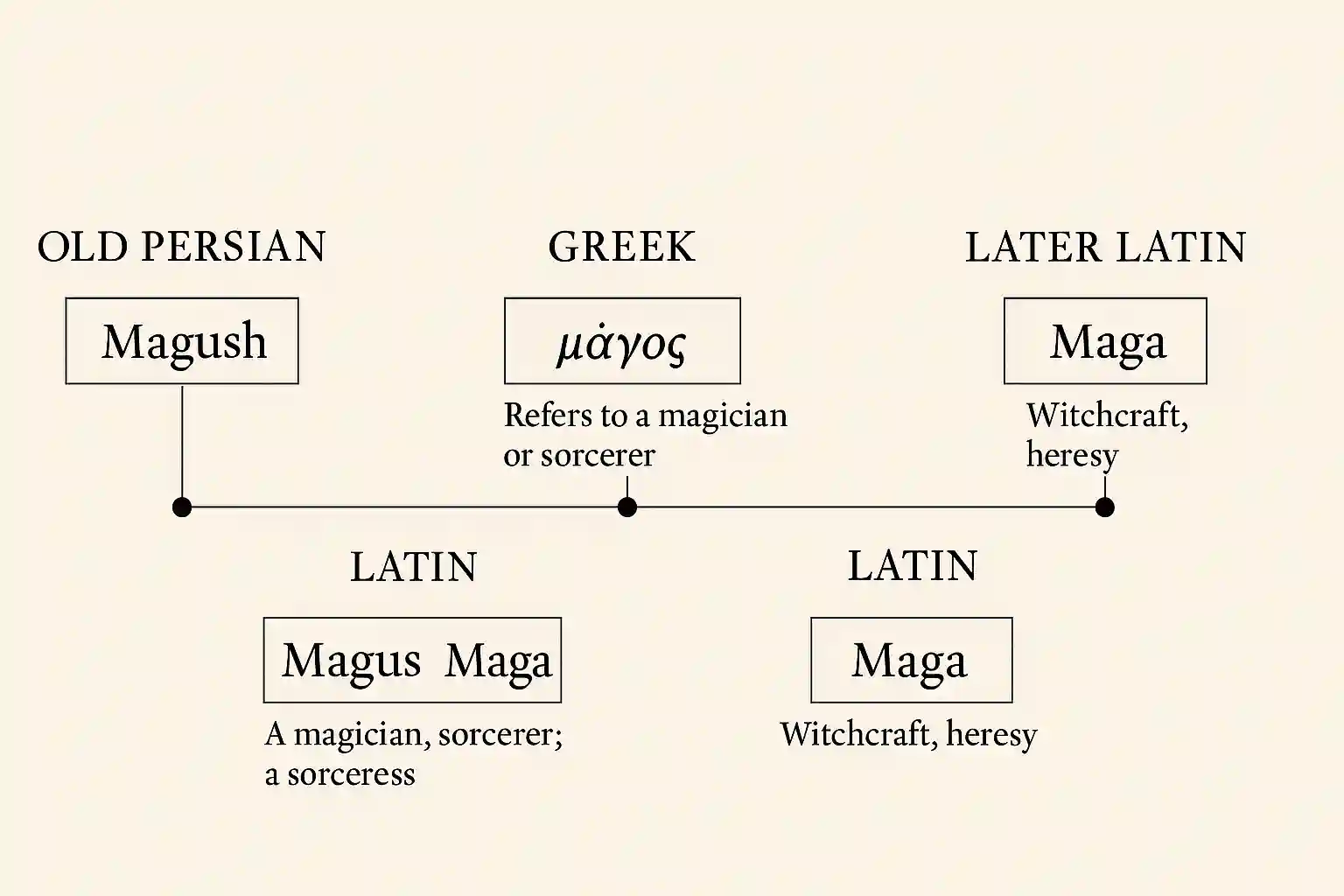
Old Persian magu- → Greek magos → Latin magus.
It describes the Magi as a designation associated with priests among western Iranian peoples and notes that the word appears in Old Persian, Elamite, Akkadian, Aramaic, Parthian, Sasanian, and classical sources.
The earliest documented occurrence discussed by Iranica appears in the famous Bisotun inscription of Darius I in connection with events of 522 BCE.
Herodotus also wrote about the Magi and connected them with Median society.
This means we are dealing with a linguistic and religious history extending more than two thousand years before modern American politics.
The development can be simplified as:
Ancient Iranian/Persian magu- → Greek magos → Latin magus → Latin feminine maga.
But the meanings also developed as the terminology moved between cultures. A designation associated with Persian priests and wise men eventually acquired additional associations with astrology, dream interpretation, magic, enchantment, and divination.
That semantic evolution helps explain why English eventually acquired words such as Magi, mage, magic, and magician from this larger historical family.
What About Hebrew and Aramaic?
Another interesting connection appears in rabbinic literature.
The respected Marcus Jastrow dictionary records the Hebrew/Aramaic term:
מגוש — magosh
and defines it as a Magian or sorcerer.
Jastrow cites its appearance in rabbinic passages including Shabbat 75a and Sotah 22a.
This does not mean that the Latin word maga originated in Hebrew.
It did not.
Instead, it demonstrates the enormous geographic reach of the Persian/Magian terminology. Related forms entered Jewish linguistic usage in antiquity and could describe Magians or sorcerers depending upon context.
Therefore the most careful conclusion remains:
Maga is not a Hebrew word meaning witch or sorceress, but related Magian terminology does occur in Hebrew and Aramaic literature.
That distinction matters whenever ancient-language evidence is being used to make a modern theological argument.
Scripture Clearly Condemns Actual Sorcery and Divination
None of this linguistic nuance changes the Bible’s condemnation of forbidden spiritual practices.
Deuteronomy 18:10–12 prohibits Israel from engaging in practices involving divination, soothsaying, sorcery, spell-casting, consulting spirits, and seeking information from the dead.
The biblical prohibition concerns practices.
This distinction is significant.
Scripture condemning sorcery establishes that believers should reject sorcery. It does not automatically establish that an English acronym becomes spiritually equivalent to sorcery because its letters happen to reproduce an ancient Latin word.
To establish that second claim, we would need evidence connecting the modern use to the ancient meaning.
That evidence has not been demonstrated.
Does Maga Have an Occult Meaning?
Here the investigation produced a finding that deserves to be added to the earlier article.
It is correct that I found no evidence showing that Maga was historically the proper name of an ancient occult religion, supernatural entity, demon, ritual, or secret spiritual system.
However, it would also be incomplete to say that the Latin term has never been adopted in a modern occult environment.
It has.
The Temple of Set Uses the Title Maga
Material describing the Temple of Set, an esoteric religious organization founded in 1975, identifies six initiatory degrees.
Among them is:
Magus/Maga V°
In this terminology, Magus is the masculine title and Maga is its feminine counterpart.
A Temple of Set information page describes the sequence as Setian I°, Adept II°, Priest/Priestess III°, Magister/Magistra Templi IV°, Magus/Maga V°, and Ipsissimus/Ipsissima VI°. The same source openly discusses practitioners as philosophers and magicians and describes the mastery of principles it calls Black Magic.
An academic discussion published through UCLA’s Anthropoetics likewise documents the Temple’s hierarchy and specifically lists Magus/Maga V.
Historical Temple of Set material attributed to founder Michael Aquino also discusses the fifth degree as Magus/Maga V°.
This is genuine evidence of the word Maga being used in a modern occult or esoteric religious context.
That deserves to be reported.
But something equally important must immediately follow it:
There Is No Documented Connection Between This Use and Political MAGA
Finding Maga inside the terminology of the Temple of Set does not demonstrate that Donald Trump borrowed the political acronym from the Temple of Set.
I found no credible evidence establishing such a connection.
There is no documented chain showing:
Temple of Set → Donald Trump → Make America Great Again.
There is no credible evidence showing that Trump’s campaign selected the phrase because maga meant enchantress in Latin.
There is no evidence showing that the campaign selected it because of magos, the Persian Magi, occult initiatory terminology, or the Temple of Set.
The existence of the Temple of Set usage makes the occult history of the word more interesting. It does not establish the occult origin of the political slogan.
That distinction is one of the most important conclusions of this investigation.
Where Did the Political Slogan “Make America Great Again” Come From?
The documented political history points in an entirely different direction.
Ronald Reagan Used the Phrase in 1980
The Smithsonian’s National Museum of American History possesses Ronald Reagan campaign material from 1980 bearing versions of the phrase.
One preserved Reagan button reads:
“Let’s Make America Great Again.”
The Smithsonian identifies the object as campaign material from Reagan’s 1980 presidential campaign. Its collection notes also observe that variations of “make America great again” have appeared in American presidential politics for decades.
Another Smithsonian record documents a 1980 Reagan button using the wording “Make America Great Again.”
The Smithsonian additionally notes that Bill Clinton used the expression “make America great again” during his 1992 campaign.
Therefore the phrase did not originate with Trump’s 2015 presidential announcement.
Trump Was Developing the Slogan in 2012
The Trump-era history also begins earlier than 2015.
In a detailed 2017 interview with The Washington Post, Trump said that he settled upon the wording “Make America Great Again” on November 7, 2012, the day after Mitt Romney lost the presidential election to Barack Obama.
Trump described experimenting with alternatives such as “We Will Make America Great” and “Make America Great” before deciding that “Again” communicated the message he wanted.
He said he wrote down the phrase and told his attorneys to investigate registering and trademarking it.
The U.S. Patent and Trademark Office confirms the existence of trademark application serial number 85783371 for MAKE AMERICA GREAT AGAIN, owned by Donald J. Trump. The mark eventually became registration number 4773272.
This documentary trail substantially strengthens the conclusion that the modern political expression originated as an English political branding phrase, not as an attempt to revive the Latin noun maga.
Trump later turned it into the centerpiece of his 2016 campaign, and the abbreviation MAGA became shorthand not merely for the slogan but eventually for a broader political movement.
What Does MAGA Mean Politically?
For research purposes, it is better to examine what the movement itself says it represents than to define it exclusively through supporters or critics.
The official 2024 Republican Party Platform was explicitly headed:
“MAKE AMERICA GREAT AGAIN!”
The document associated the program with immigration enforcement, expanded domestic energy production, manufacturing, tax policies, constitutional rights, military strength, trade policy, education policy, Social Security and Medicare, election policy, and what it characterized as an “America First” approach to government and foreign affairs.
People can strongly agree or disagree with those policies. That political debate is separate from the linguistic question being examined here.
Historically and politically, however, MAGA has a clearly documented modern definition and political program.
Is the Identical Spelling Significant?
This brings us to perhaps the hardest question.
How should we understand the remarkable fact that:
MAGA = Make America Great Again
while:
maga = female magician/enchantress in Latin?
The similarity is real.
But similarity is not the same thing as etymology.
An etymological relationship requires a historical pathway showing that one expression developed from another.
For the modern political acronym, the historical evidence instead gives us a readily understandable English formation:
Make
America
Great
Again
Taking the initial letters produces:
M-A-G-A.
Meanwhile, the ancient Latin noun had already existed independently for centuries.
Without evidence demonstrating borrowing, the safest historical conclusion is that these are independent formations that happen to produce the same sequence of letters.
The coincidence may be surprising.
It may invite theological reflection.
It may even cause someone personally to view the slogan differently.
But none of those responses constitutes historical proof that the modern acronym was intentionally constructed from the Latin word.
Can Coincidence Still Have Spiritual Significance?
That is no longer a linguistic question.
It is a theological one.
A believer can reasonably ask whether words, images, symbols, slogans, political movements, governments, institutions, or cultural phenomena deserve spiritual examination.
Scripture repeatedly warns Elohim’s people against deception, idolatry, forbidden spiritual practices, misplaced allegiance, and falsehood.
But biblical discernment should be based upon evidence rather than allowing an interesting coincidence to become evidence of something it cannot independently establish.
If someone wishes to make a theological case concerning MAGA—or any other political movement—that case should examine what the movement teaches, what its leaders do, what principles it promotes, what allegiances it demands, whether its claims are true, and how those things compare with Scripture.
That would be a much stronger theological argument than simply saying:
“Maga means enchantress in Latin; therefore political MAGA is occult.”
The first part of that statement is documented.
The word therefore is where evidence becomes necessary.
At present, the historical evidence does not establish that conclusion.
An Important Warning About Etymology
There is another lesson here that extends far beyond MAGA.
Words routinely change meaning as they move across centuries and languages. Sometimes words that share an ancient root develop dramatically different meanings. Other times two unrelated expressions accidentally acquire identical spelling.
The historical origin of a word can help explain its development, but ancient etymology does not automatically determine every later meaning.
The biblical evidence concerning magos itself demonstrates this principle beautifully.
Matthew uses magoi for the visitors from the East who sought the Messiah. Acts uses magos for Elymas, a magician who opposed the faith.
The same lexical family appears in dramatically different contexts.
Therefore sound interpretation requires more than finding an ancient dictionary definition.
It requires context.
What the Evidence Supports—and What It Does Not
After expanding the original investigation, these conclusions appear supportable.
Supported by historical evidence
Latin maga can mean a female magician or enchantress.
Greek magos was connected with Persian Magians and wise men but could also develop meanings involving magicians, enchanters, or impostors.
The larger word family reaches back into ancient Iranian and Persian history.
Related magosh terminology appears in rabbinic Hebrew and Aramaic literature.
The New Testament uses magoi in Matthew’s account of the visitors from the East and magos for Elymas in Acts.
The Temple of Set has genuinely used Magus/Maga V° as an initiatory title.
Ronald Reagan used versions of “Make America Great Again” in his 1980 presidential campaign.
Trump’s documented use of the slogan reaches back to 2012, before his 2015 presidential campaign announcement.
Not established by the evidence
There is no credible evidence I located demonstrating that Donald Trump selected the slogan because of the Latin definition of maga.
There is no demonstrated historical connection between Trump’s MAGA slogan and the Temple of Set.
There is no evidence demonstrating that MAGA was deliberately constructed as an invocation of a spirit, magical entity, ancient deity, or occult ritual.
The fact that maga appears in both ancient magical vocabulary and modern occult terminology does not establish that the political acronym was derived from either one.
These distinctions should not weaken biblical discernment. They strengthen it by separating what we know from what we suspect or interpret.
Final Verdict: What Does MAGA Really Mean?
The deepest investigation leads to an answer with several layers.
In Latin, maga can mean a female magician or enchantress. That definition is genuine and historically documented.
In Greek, the related magos referred historically to Persian Magians and wise men and later acquired additional meanings including magician or enchanter.
In ancient Persian and Iranian history, the word family is connected with the Magi and priestly figures.
In rabbinic Hebrew and Aramaic, related terminology such as magosh can refer to a Magian or sorcerer.
In the Bible, the word family appears in more than one context: Matthew’s magoi come seeking the Messiah, while Acts identifies Elymas as a magos who opposes the faith.
In modern occult history, Maga has genuinely been used as the feminine counterpart of Magus in the Temple of Set’s initiatory hierarchy.
And in modern American politics, MAGA means Make America Great Again, an English slogan with documented precedents in earlier American presidential politics and a Trump-specific documentary trail beginning in 2012.
What the research does not establish is that these ancient, occult, and political uses are historically connected merely because they share the letters M-A-G-A.
The Latin definition is real.
The occult title is real.
The political acronym is real.
The supposed secret connection between them remains unproven.
For believers, perhaps the larger lesson is that spiritual discernment becomes stronger—not weaker—when we refuse to confuse evidence with speculation. We can examine political movements carefully. We can test their claims, their actions, their loyalties, and their values against Scripture. We can investigate unusual words and symbols. But when we say something is historically established, we should be able to demonstrate it.
That is especially important when theology and politics meet.
Frequently Asked Questions
Does maga really mean “sorceress”?
The exact Latin word maga is documented as the feminine counterpart of magus and can mean a female magician or enchantress.
Does maga mean sorceress in Greek?
Not exactly. The historically related Greek word is magos (μάγος). It could refer to a Persian Magian or wise man and, in other contexts, to an enchanter, wizard, or magician.
Is maga a Hebrew word?
Not in the Latin sense discussed here. Rabbinic Hebrew and Aramaic contain related words such as magosh, but the Latin maga should not be presented as originating in Hebrew.
Were the biblical Magi connected with this word family?
Yes. Matthew 2:1 uses the Greek plural magoi (μάγοι) for the visitors from the East.
Is Maga used by an occult organization?
Yes. The Temple of Set has used Magus/Maga V° within its hierarchy of initiatory degrees.
Does that prove political MAGA is connected to the Temple of Set?
No. I found no credible historical evidence demonstrating such a connection.
Did Donald Trump invent the words “Make America Great Again”?
No. Ronald Reagan used versions of the slogan in his 1980 presidential campaign, and Smithsonian artifacts document that history.
When did Trump begin using the slogan?
Trump says he settled upon the wording after the 2012 presidential election. His trademark activity began before his 2015 presidential campaign, and USPTO records document the trademark associated with Donald J. Trump.
Does the Latin definition prove that the political acronym has an occult meaning?
No. It proves that an ancient Latin word with identical spelling has a magical meaning. Establishing deliberate occult derivation would require additional historical evidence that has not been found.
Research Sources
Lewis & Short, A Latin Dictionary — magus/maga. Primary lexical evidence that Latin maga can mean a female magician or enchantress.
Liddell-Scott-Jones Greek Lexicon / Scaife ATLAS — μάγος. Documents the Greek term’s connection with Median/Persian Magians, priests, wise men, and dream interpreters.
Encyclopaedia Iranica — “Magi” — Scholarly history of Old Persian magu-, Greek magos, Latin magus, and the Iranian priestly background.
Marcus Jastrow, A Dictionary of the Targumim, Talmud Babli and Yerushalmi, and Midrashic Literature — Documents magosh as Magian/sorcerer terminology in rabbinic literature.
Matthew 2:1 Greek Interlinear — Documents magoi (μάγοι) in Matthew’s account of the visitors from the East.
Acts 13:8 Greek Interlinear — Documents magos (μάγος) for Elymas the magician/sorcerer.
Sefaria, Deuteronomy 18:10–12 — Hebrew biblical source concerning divination, sorcery, and prohibited spiritual practices.
Temple of Set / Xeper information material — Documents Magus/Maga V° within the organization’s initiatory structure and its description of Black Magic.
UCLA Anthropoetics — Study of the Temple of Set — Independent academic documentation of the six-degree hierarchy including Magus/Maga V.
Michael Aquino, Temple of Set historical material — Additional documentation concerning the Magus/Maga V° degree.
Smithsonian National Museum of American History — Reagan campaign artifacts documenting versions of “Make America Great Again” from 1980.
United States Patent and Trademark Office — Federal trademark documentation for MAKE AMERICA GREAT AGAIN, serial number 85783371 and registration number 4773272.
The Washington Post — Trump interview concerning the origin of the slogan — Trump’s account of developing “Make America Great Again” following the 2012 election and directing attorneys to pursue trademark protection.
2024 Republican Party Platform, American Presidency Project — Primary-source documentation showing how “Make America Great Again” was incorporated into the Republican Party’s modern political platform.
Discover more from Rickey A. McElderry
Subscribe to get the latest posts sent to your email.